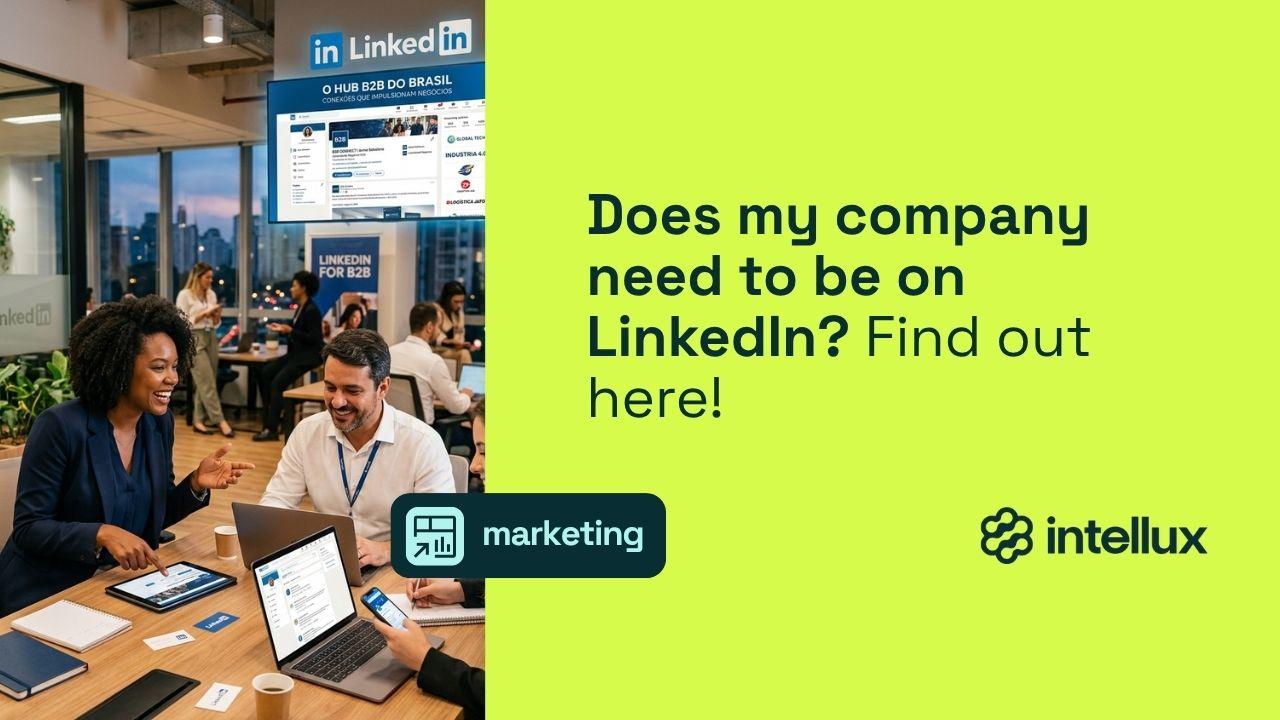
When a B2B company begins structuring its digital presence, one of the first questions that comes up is: does my company need to be on LinkedIn? The question makes sense, since the platform is strongly associated with business, networking, authority, and professional relationships.
But being on LinkedIn should not be an automatic decision. Not every B2B company finds its best customers on the platform, and not every brand, sales, or demand generation strategy needs to start with digital. In many markets, offline actions, commercial relationships, events, trade shows, in-person visits, and referrals can generate more impact than an intense posting routine.
In this article, we will explain when it makes sense for a B2B company to be on LinkedIn, which strategies tend to work on the platform, and in which cases offline media can be more effective. The goal is to help your company make a more strategic decision: not to be where everyone else is, but to be where your customer is actually paying attention.
Why do companies create an account on LinkedIn?
Companies create an account on LinkedIn because they see the platform as an environment naturally connected to business, careers, networking, and professional reputation. Unlike networks that are more focused on entertainment or personal relationships, LinkedIn is perceived as a space where brands, specialists, managers, and decision-makers can talk about the market, solutions, challenges, trends, and commercial opportunities.
For B2B companies, this tends to matter even more. Since sales between companies usually involve more trust, comparison between suppliers, and validation of authority, many brands use LinkedIn as an institutional showcase. The company page, the founders’ profiles, the content published, and employee interactions help potential customers understand who is behind that brand.
In practice, companies create an account on LinkedIn for reasons such as:
- Increasing brand credibility with customers, partners, and talent;
- Being found by decision-makers who research suppliers before starting a commercial conversation;
- Sharing content, case studies, events, and business updates;
- Strengthening employer branding by attracting more qualified professionals;
- Supporting the sales team, especially in consultative sales and longer sales cycles;
- Building authority on topics relevant to the market;
- Following competitors, trends, and industry movements.
The problem begins when a company creates an account only because “everyone is on LinkedIn.” Without clarity on audience, positioning, goals, and consistency, a presence on the platform can become just another marketing task, with no real impact on demand generation or brand building.
That is why, before creating or investing in a LinkedIn page, the company needs to understand whether the platform makes sense within its strategy. Being present can be important, but being present without knowing what to communicate, who to communicate with, and for what purpose rarely generates results.
Proven results on LinkedIn and the advantage of using this social network
LinkedIn has numbers that justify its relevance in the B2B market. The platform itself presents itself as the largest professional network in the world, with more than 850 million members in over 200 countries and regions. This explains why so many companies see the network as an important space for professional relationships, authority, and brand visibility.
In addition, in the B2B Content Marketing Benchmarks & Trends 2025 study by the Content Marketing Institute, 85% of B2B marketing professionals said LinkedIn is the social platform that delivers the most value to their organizations. The same report shows that 68% of professionals increased their use of LinkedIn in the 12 months prior to the survey.
These numbers show that LinkedIn can generate important results for B2B companies, especially in areas such as:
- Brand awareness, when the company appears frequently to the right audience;
- Market authority, when it shares useful and relevant knowledge;
- Relationships with decision-makers, when founders, leaders, and salespeople take part in the conversation;
- Demand generation, when content helps the customer understand problems and consider solutions;
- Commercial validation, when the prospect researches the company before moving forward in a negotiation.
But there is an important point: proven results do not mean guaranteed results for every company. LinkedIn works best when there is alignment between audience, message, offer, and buying journey.
A company that sells software to financial directors, for example, may find LinkedIn to be a strong channel for educating the market and generating qualified conversations. On the other hand, an industry that sells to technical buyers in specific regions may get better returns from trade shows, commercial visits, representatives, industry events, and offline media.
In other words: the data shows that LinkedIn is relevant for B2B, but it does not prove that every B2B company needs to treat it as a priority. The decision should start with a simple question: is your customer using LinkedIn as a source of information, validation, or relationship-building before buying?
How do I know if my company needs to be on LinkedIn?
To know whether your company needs to be on LinkedIn, the first step is to understand whether the platform is part of your customer’s decision-making journey. It is not enough for LinkedIn to be a relevant network for business. It needs to be relevant to your market, your type of sale, and the buyer profile you want to reach.
Many B2B companies join LinkedIn because they see other brands publishing content, building authority, and creating relationships. But copying this movement without a strategy can lead to frustration. Before investing time, team effort, and budget into the network, it is important to answer a few questions:
- Does my ideal customer use LinkedIn frequently?
- Are the purchase decision-makers present on the platform?
- Does my market value content, authority, and digital reputation?
- Does the sale depend on trust, education, and relationship-building?
- Does my company have something relevant to communicate consistently?
- Does LinkedIn help the sales team open doors or validate the brand?
- Are there offline channels generating better results today?
If the answer is “yes” to many of these questions, LinkedIn probably deserves attention. But if your audience buys through referrals, in-person relationships, trade shows, sales representatives, or technical visits, the network may not need to be an immediate priority.
The main point is: your company does not need to be on LinkedIn just because other companies are. It needs to be where the right customer is paying attention.
Do B2B companies necessarily need to be on LinkedIn?
No. B2B companies are not required to be on LinkedIn.
Although LinkedIn is a network strongly associated with the corporate market, this does not mean that every B2B company needs to invest heavily in the platform. There are B2B businesses where the purchase decision happens far away from social media, especially in more technical, industrial, regional, or relationship-based markets.
For example, a company that sells solutions to large industries may get better results by participating in industry trade shows, making commercial visits, creating technical printed materials, or strengthening relationships with buyers and engineers than by posting three times a week on LinkedIn.
Similarly, a company operating in very specific niches may find that its decision-makers do not use LinkedIn as their main source of information. They may be present at in-person events, industry associations, closed groups, technical communities, conferences, business meetings, or direct conversations with trusted suppliers.
This does not mean the company should completely ignore LinkedIn. In many cases, it is worth having at least a basic presence, with:
- An updated institutional page;
- A clear description of what the company does;
- Website, location, and contact information;
- Main solutions or segments served;
- Occasional credibility-building content;
- Leader profiles aligned with the brand’s positioning.
This minimal presence helps with validation. When a potential customer researches the company, they find a brand that is active, coherent, and trustworthy. But this is different from turning LinkedIn into the main marketing channel.
Therefore, the question should not be: “Are B2B companies required to be on LinkedIn?”
The right question is: “Does LinkedIn influence the way my customer discovers, evaluates, or chooses suppliers?”
If it does, it is worth investing. If it does not, there may be more strategic channels.
Do B2B companies on LinkedIn make sense?
B2B companies on LinkedIn make sense when the platform helps build trust, educate the market, create relationships, or support the sales process. This happens mainly in more consultative sales, with longer cycles, higher average tickets, and the involvement of multiple decision-makers.
In these cases, customers rarely buy at the first contact. They research, compare alternatives, evaluate risks, talk to other people in the company, and look for signs of credibility. LinkedIn can help precisely in this consideration stage.
A well-built presence can show that the company understands the market, knows the customer’s pain points, and has the experience to solve specific problems. This can happen through educational content, case studies, expert opinions, project behind-the-scenes content, participation in events, and publications from company leaders.
LinkedIn usually makes more sense for B2B companies that:
- Sell to leadership, management, or executive roles;
- Work with complex or consultative solutions;
- Need to educate the market before the sale;
- Depend on reputation and authority to generate trust;
- Have founders, executives, or specialists with a strong market perspective;
- Operate in segments such as technology, consulting, marketing, sales, HR, finance, legal, corporate education, innovation, industry, or professional services;
- Have a sales team that uses the platform for prospecting and relationship-building.
On the other hand, LinkedIn may make less sense as a priority when:
- The buyer does not use the platform to research suppliers;
- The market is highly regional or in-person;
- The decision depends more on price, logistics, or long-standing relationships;
- The sale happens through distributors, representatives, or physical channels;
- The company does not have the structure to maintain consistent communication;
- Other channels already generate better results with less effort.
That is why LinkedIn should be analyzed as part of the strategy, not as a universal rule. For some companies, it will be a strong channel for authority and demand generation. For others, it will be only an institutional showcase. And, in some cases, offline media can be more effective for creating recall, closeness, and trust.
The most important thing is to understand the role of the network within the customer journey. LinkedIn may not close the sale by itself, but it can help the customer trust the company more before speaking with the sales team.
How do personal brands on LinkedIn make sense?
Personal brands on LinkedIn make sense when strategic people in the company help represent the business’s vision, authority, and credibility. In many cases, the profile of a founder, partner, director, or specialist generates more reach, connection, and trust than the company’s institutional page.
This happens because people connect with people. A piece of content published by a founder sharing a market perspective, a commercial experience, or an opinion about the industry tends to feel more approachable and authentic than a traditional corporate post.
In B2B, this can be very powerful. The buying decision involves trust, and personal branding helps humanize the company. The customer does not see only a logo; they see who thinks, leads, and delivers behind the solution.
Personal brands on LinkedIn can help the company:
- Increase the authority of founders and leaders;
- Generate conversations with potential customers;
- Strengthen the company’s positioning;
- Attract talent and partners;
- Educate the market with more proximity;
- Support the sales team with reputation and proof of expertise;
- Create a more human and trustworthy perception of the brand.
This movement is commonly called Founder Led Marketing, or marketing led by the founder. The idea is to use the voice of company leaders as an asset for growth, reputation, and relationship-building.
But this does not mean turning every founder into an influencer. A B2B personal brand does not need to be based on excessive exposure, generic phrases, or self-promotion. It works best when there is consistency, a clear point of view, and useful content for the right audience.
Some formats that work well for personal brands on LinkedIn are:
- Real learnings from the operation;
- Opinions about market changes;
- Behind the scenes of strategic decisions;
- Analyses of industry trends;
- Company mistakes and wins;
- Customer stories, without exposing sensitive information;
- Reflections on leadership, sales, product, or growth;
- Educational content connected to the company’s area of expertise.
For a B2B company, personal branding can be even more important than the corporate page, especially when the market values relationships, trust, and technical knowledge. Instead of trying to make the company “look human,” the brand can use the people who are already part of it to build that connection more naturally.
However, just like the company’s presence on LinkedIn, personal branding also needs strategy. It is not enough to post for the sake of posting. It is necessary to define the audience, main topics, tone of voice, goals, and how this presence connects to the company’s positioning.
When done well, the personal brand does not replace the corporate brand. It expands its strength. While the company supports institutional credibility, leaders help create proximity, trust, and relationships with the market.
What strategies are most used on LinkedIn?
On LinkedIn, B2B companies usually use the platform for three main goals: building authority, generating relationships, and supporting sales. The difference lies in who communicates: the brand, the founders, the leaders, or the sales team.
Not every strategy needs to involve a high volume of posts. In many cases, the most important thing is to have clear positioning, consistency in the topics, and a message aligned with the customer journey.
The most common strategies for B2B on LinkedIn are:
1. Founder Led Marketing strategy, for personal brands
Founder Led Marketing, or FLM, is a strategy in which founders, partners, or company leaders use their own profiles to communicate market vision, learnings, opinions, and behind-the-scenes insights from the business.
This approach works well because people tend to create more proximity than institutional pages. In B2B, where trust carries a lot of weight in the buying decision, an active founder presence can help humanize the brand and open conversations with customers, partners, and talent.
In practice, FLM can include:
- Opinions about the market;
- Learnings from the operation;
- Behind the scenes of growth;
- Views on trends;
- Real company stories;
- Reflections on customers and industry challenges.
The goal is not to turn the founder into an influencer, but to make them a trusted voice within the market in which the company operates.
2. Institutional authority strategy, for B2B brands
The institutional authority strategy uses the company page to reinforce credibility, positioning, and market knowledge. Here, the focus is not on going viral, but on showing that the brand understands the customer’s problem and has the expertise to solve it.
This strategy usually works well for B2B companies that need to educate the market before the sale, such as consultancies, technology companies, industries, agencies, specialized firms, and businesses with consultative sales.
Content may include:
- Success cases;
- Market analyses;
- Educational content;
- Participation in events;
- Solution launches;
- Research, data, and reports;
- Technical or institutional behind-the-scenes content.
The company page works as a trust showcase. Even if the customer does not discover the brand through LinkedIn, they may use the platform to validate whether the company is serious, active, and consistent with what it promises.
3. Social selling strategy, for B2B brands
Social selling uses LinkedIn to support the commercial process. In this case, the network is not used only to publish content, but to build relationships with potential customers before, during, and after the sales approach.
It is a common strategy in B2B companies with consultative sales, long cycles, and higher average tickets. The sales team can use LinkedIn to map decision-makers, follow company movements, interact with relevant content, and start conversations in a less cold way.
In practice, social selling involves:
- Connecting with strategic leads;
- Interacting with prospects’ publications;
- Sending personalized messages;
- Sharing useful content;
- Following job and company changes;
- Strengthening the authority of salespeople.
The key point is to avoid an aggressive approach. Social selling is not about sending sales messages to everyone. It is about building presence, context, and trust so that the commercial conversation happens more naturally.
When does offline media make sense for B2B?
Offline media makes sense for B2B companies when in-person relationships, physical presence, and trust-building carry more weight than digital exposure.
This often happens in industrial, technical, regional, or highly specialized markets. In some segments, the buyer does not make a decision because they saw a post on LinkedIn, but because they spoke with a supplier at a trade show, received a referral, attended an event, or had direct contact with a sales representative.
Offline actions may include:
- Trade shows and industry events;
- Commercial visits;
- Technical printed materials;
- Event sponsorships;
- Activations at conferences;
- Customer meetings;
- Relationships with associations;
- Media in specialized magazines or channels.
Offline can also be more effective when the audience is restricted, the sales cycle depends on trust, or the company needs to be present at key moments in the industry. For many B2B brands, the best strategy is not choosing between online and offline, but understanding which channel has the greatest influence on the customer’s decision.
Being on LinkedIn can be important, but knowing how to position yourself is worth much more
Being on LinkedIn can help a B2B company gain visibility, authority, and credibility. But a presence on the platform alone does not guarantee results.
Before publishing, advertising, or creating a content routine, the company needs clarity about its positioning. This means knowing who it wants to reach, what problem it solves, why it is different, and which channels the customer actually pays attention to.
For some companies, LinkedIn will be a strategic channel. For others, it will only be an institutional showcase. And, in many cases, offline media can generate more relationships, brand recall, and commercial opportunities.
The most important thing is not to follow a ready-made formula. A good B2B strategy starts by understanding the market, the buyer, and the decision-making journey.
If your company wants to understand which channels make the most sense to grow with positioning, authority, and qualified demand, count on a strategy designed for your market, not just for the algorithm.