
SEO


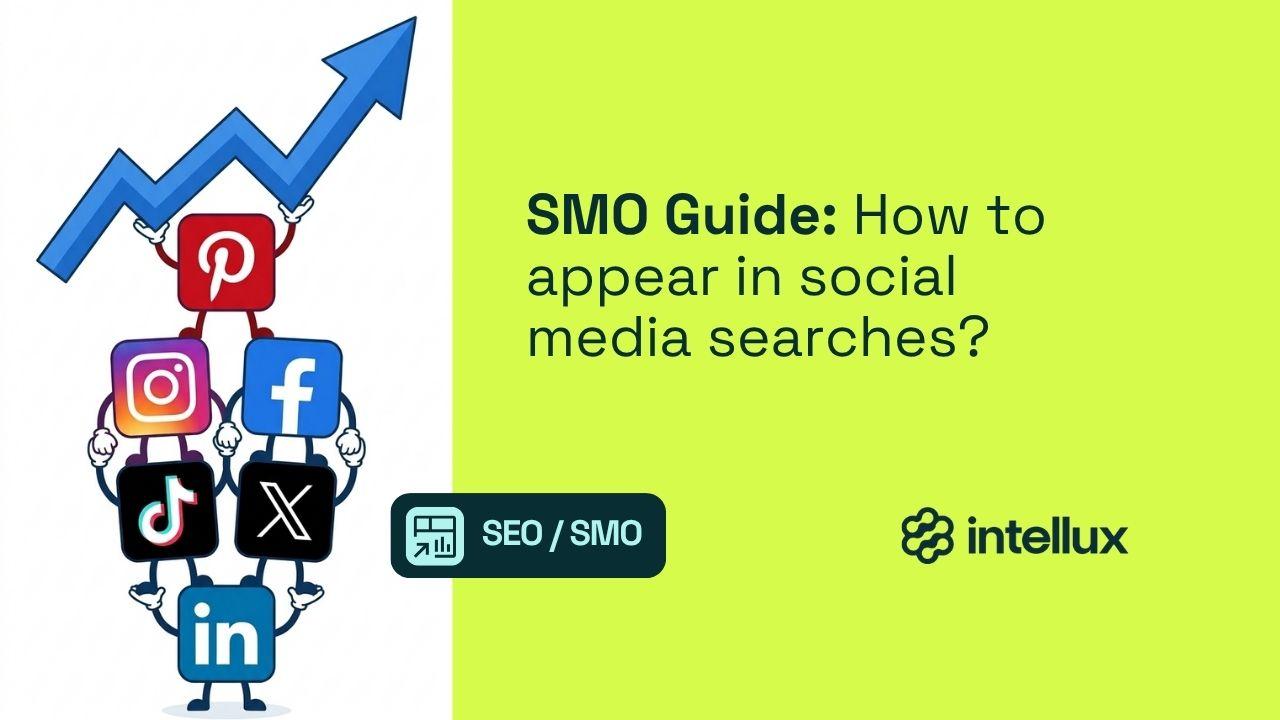
If you follow Intellux’s blog and social media channels, you have already learned everything about how to appear in Google results through SEO (Search Engine Optimization), a set of techniques used to position your websites and blogs at the top of search engines.
However, user behavior has changed a lot, and more and more people use social networks as search tools to find products, services, recommendations, and reviews.
In this context, SMO (Social Media Optimization) emerges as a set of strategies focused on optimizing content published on social media, with the goal of improving its visibility within the platforms themselves.
Just as we use SEO to rank on Google, it is necessary to help social media algorithms understand what your content is about so that it can be better indexed, distributed, and recommended to users searching for related topics.
In this article, we will explain how SMO works and which factors help content be identified, indexed, and distributed by social media algorithms.
SMO stands for Social Media Optimization. In practice, it is a set of strategies used to improve the visibility of content within social media platforms themselves, helping posts, videos, Reels, Shorts, carousels, and profiles appear in internal searches, explore sections, recommendations, and results suggested by algorithms.
While many brands used to see social media only as channels for posting and relationship-building, SMO shows that these platforms also work as search environments. Today, a person can search on Instagram for “Japanese restaurant in São Paulo”, on TikTok for “best sunscreen for oily skin”, or on YouTube for “how to create a digital marketing strategy”. That is why content needs to be created in a clear, searchable way and aligned with what the audience is actually looking for.
In practice, doing SMO involves actions such as:
For example, a beauty clinic that wants to appear to people searching for skin cleansing can create a video titled “How does professional skin cleansing work?”, use that expression in the caption, mention the term during the video, insert the text on screen, and use hashtags related to the topic. These signals help the social network understand the subject of the content and recommend it to people interested in that type of search.
SEO and SMO have similar goals, but they work in different environments. SEO, Search Engine Optimization, seeks to improve the visibility of websites, blogs, and pages in search engines, such as Google. SMO, Social Media Optimization, seeks to improve the visibility of content published on social media, such as Instagram, TikTok, YouTube, Pinterest, LinkedIn, and other platforms.
The practical difference lies in where the optimization happens and in the type of content being worked on. In SEO, the brand optimizes pages, blog articles, product descriptions, images, URLs, titles, and meta descriptions to appear better in Google results. In SMO, the brand optimizes captions, videos, hashtags, titles, on-screen text, bios, scripts, and post formats to appear better within social media platforms.
In practice, the difference looks like this:
A simple example helps make this clearer. If an English school wants to attract people interested in learning the language, in SEO it can publish an article called “How to learn English faster”. In SMO, it can create a short video titled “5 English phrases to use when traveling”, using keywords in the caption, on-screen text, hashtags, and a call to save the content.
In other words, SEO helps the brand be found in traditional search engines, while SMO helps the brand be found within social media platforms. When both strategies work together, the digital presence becomes stronger, because the company starts appearing both on Google and on the platforms where the audience consumes content every day.
To appear in social media searches, publishing frequently or following visual trends is not enough. You need to create content that can be easily understood by algorithms while also being useful to the audience searching for a specific topic. This means using keywords, clear titles, well-written captions, and formats that help the platform identify the subject of the post.
In practice, SMO works as an adaptation of SEO for the social media environment. Instead of optimizing a page for Google, the brand optimizes posts, videos, Reels, Shorts, carousels, and descriptions so they can be found on platforms such as Instagram, TikTok, YouTube, Pinterest, and LinkedIn.
Captions are one of the main ways to indicate to the algorithm what the content is about. That is why it is important to include terms that the audience would actually use to search for that topic within the social network.
Instead of writing a generic caption, such as “check out this tip”, it is better to use a more specific structure, such as “see how to optimize your Instagram profile to appear in searches”. This way, the platform can connect the content to topics such as Instagram, profile optimization, social media search, and digital marketing.
Keywords should appear naturally, without excess or forced repetition. The goal is to make the content clearer for the algorithm and more useful for those reading it.
On platforms such as YouTube, TikTok, Instagram Reels, and LinkedIn, the title or the first sentence of the video is very important. It helps users quickly understand the topic and also contributes to the content being classified correctly.
A title like “3 mistakes that prevent your brand from appearing on Instagram” tends to be more effective than a vague hook, such as “you need to know this”. Besides sparking curiosity, it informs the main subject and increases the chances of the video being found by people interested in the topic.
Whenever possible, the title should answer a question, present a clear promise, or indicate a direct benefit for the audience.
Social media algorithms also analyze elements within the content itself, such as speech, text displayed on the screen, and visual context. That is why the most important terms should not appear only in the caption, but also in the video script.
If the content is about SEO for social media, for example, it is worth mentioning expressions such as “Instagram search”, “TikTok algorithm”, “content optimization”, and “how to appear on social media” during the recording.
This practice helps reinforce the content’s topic and improves its association with searches made by users within the platform.
Hashtags can still help organize and discover content, as long as they are used strategically. The ideal approach is to avoid very generic hashtags or hashtags disconnected from the topic and prioritize terms that represent the subject of the post.
In content about SMO, for example, hashtags like these may make sense:
The most important point is that the hashtags must be aligned with the content. They should work as classification tags, helping the platform understand which audiences and searches that post may be relevant for.
Text inserted directly into images, carousels, and videos also helps identify the topic. In addition, it makes the content easier for users to scan, mainly on networks where the decision to keep watching or reading happens in just a few seconds.
In a video about SMO, for example, the opening screen can display a phrase such as “How to appear in Instagram searches?”. In a carousel, the first slide can present the topic directly, while the following slides develop practical tips.
This feature improves the user experience and reinforces the signals sent to the algorithm about the topic being addressed.
To appear in social media searches, the brand needs to think like the audience searches. Many users look for quick answers to specific questions, such as “how to improve reach on Instagram?”, “how to appear on TikTok?” or “how to optimize videos on YouTube?”.
That is why content in question-and-answer format, tutorials, lists, quick guides, and objective explanations tends to perform well. These formats directly meet search intent and increase the chances of retention, saves, and shares.
The more useful the content is in solving a real question, the greater its relevance will be for the audience and for the algorithm.
Besides understanding the topic of the post, algorithms observe how people interact with it. Content that receives comments, saves, shares, and higher watch time tends to be interpreted as relevant.
To encourage these actions, it is important to create posts with practical value. Checklists, step-by-step guides, applicable tips, comparisons, and educational content usually generate more saves. Open-ended questions, opinions, and debate topics can encourage comments.
It is also worth including simple calls to action, such as “save this content to check later”, “send this to someone who needs to improve their social media”, or “comment which of these tips you already use”.
Scannability also influences performance. On social media, audiences usually consume information quickly, so well-organized content tends to retain more attention.
Use direct sentences, divide the subject into topics, avoid long blocks of text, and highlight the main idea right at the beginning. In videos, introduce the topic quickly and maintain a logical sequence. In carousels, each slide should present clear information and complement the previous one.
The easier the content is to consume, the greater the chances that the user will stay, interact, and recommend it to other people.
Content optimized for social media needs consistency between caption, title, hashtags, script, and final delivery. If the hook promises to explain how to appear in Instagram searches, the content must actually provide guidance on that topic.
This consistency helps the algorithm classify the post more accurately and improves the user experience. When the audience finds exactly what they were looking for, they tend to stay longer and interact more often.
Therefore, optimizing content for social media searches involves combining thematic clarity, strategic use of keywords, good information structure, and engagement incentives. This combination increases the chances of the post being found, recommended, and distributed to people interested in the topic.
For a long time, social media management was mainly associated with creating creative content and maintaining a posting frequency. However, with the evolution of algorithms and the growing use of social networks as discovery tools, it became necessary to go beyond simply publishing posts. Today, understanding how platforms interpret and distribute content has become an essential part of digital strategy.
In the context of SMO (Social Media Optimization), the starting point is that algorithms need to clearly understand what each published piece of content is about. To do this, platforms analyze several elements that help contextualize the post:
These elements work as signals that help platforms classify and categorize content. Based on them, algorithms select and recommend posts according to relevance criteria and user interests.
When this information is clear and consistent with the content topic, algorithms can classify it more accurately. As a result, the chances increase that the post will be associated with certain search intents and appear to users who are searching for or consuming related content within the social network itself.
Instead of relying exclusively on Google to find answers, many people have started using AI or social networks as search tools.
A user might search directly on Instagram for restaurant recommendations, look on TikTok for product reviews, or use YouTube to find tutorials and explanations about certain topics.
This type of behavior shows that social platforms have started to play a role similar to search engines. Within them, people use keywords to find specific content, explore specialized profiles, and browse recommendations suggested by algorithms.
In this scenario, content optimization for social media is no longer just an aesthetic or creative matter, but also a strategic one. Creating content that can be easily interpreted by algorithms increases the chances of being found by new users.
In addition to elements related to indexing and search, platforms also analyze behavioral signals generated by users’ interactions with the content.
Metrics such as watch time, likes, comments, shares, and saves work as indicators of relevance. When content generates higher levels of engagement, algorithms interpret that it has value for the audience and tend to expand its distribution.
This means that social media optimization does not depend only on how the content is described or categorized, but also on how it is consumed by the audience. Formats that encourage interaction, such as questions, lists, stories, or educational content, tend to generate more comments, shares, and saves. The greater a piece of content’s ability to retain attention and stimulate interactions, the greater its chances of being distributed by algorithms and reaching a wider audience.
For this reason, SMO strategies involve both organizing the information that accompanies the content and creating formats that favor engagement. The combination of thematic clarity and audience interaction helps algorithms recognize the content as relevant and expand its distribution.
With the growth of social networks as discovery environments, SMO has consolidated itself as a natural extension of SEO strategies within digital marketing. If optimization efforts were once focused on traditional search engines, it is now necessary to also consider the internal search systems of social platforms.
For brands, companies, and professionals that use social media as a communication and customer acquisition channel, understanding this dynamic is becoming increasingly important. The ability to produce content that can be found, interpreted, and distributed by platforms represents a significant competitive advantage in an increasingly competitive digital environment.
Therefore, SMO should not be understood only as a set of isolated techniques, but as a strategic approach focused on aligning content production, audience behavior, and the way social media algorithms work.
Continue exploring related content that might interest you