Marketing Strategy

What is and how to create the consumer journey

Learn how to map, analyze, and optimize the consumer journey to increase your sales and improve customer experience.

Alycia Zhu
Alycia Zhu
Published on April 02, 2026
5 min de leitura
Loading sharing options...
What is and how to create the consumer journey

 The consumer journey structures marketing by guiding communication according to the audience’s level of awareness, avoiding generic approaches that reduce results and weaken strategic performance. In addition, it allows companies to distribute content and campaigns strategically across each stage, increasing efficiency and improving conversion rates. As a result, businesses can reduce wasted investment while strengthening relationships with leads, guiding the consumer more clearly toward a confident and well-informed decision.

In the case of physical products, the journey involves visual and comparative stimuli, where factors such as price, reviews, and logistics directly influence the purchase decision and perceived value. On the other hand, digital products require a more educational journey, with content that demonstrates value and authority before the consumer feels secure enough to buy. Therefore, communication must anticipate doubts and reinforce benefits clearly, since there is no physical interaction with the product.

When it comes to services, the journey depends heavily on building trust, since the client evaluates delivery capability before closing a deal. In this context, reputation, social proof, and service quality become decisive factors in converting interest into actual hiring decisions. Finally, the post-sale stage gains greater importance, since the delivered experience directly impacts customer loyalty and the generation of new referrals over time.

What is the consumer journey?

The consumer journey is the path a person takes from the first contact with a brand to the purchase decision and the relationship in the post-sale stage. This process involves stages such as awareness, consideration, decision, and loyalty, which help companies understand audience behavior in a more structured way. With this understanding, marketing can adapt messages, channels, and strategies to better meet customer needs at each phase.

The concept did not originate from a single sociologist, but was developed over time by scholars of consumer behavior and marketing theory. Authors such as Philip Kotler, considered one of the main theorists of modern marketing, helped structure this perspective by addressing the purchase decision process. In addition, researchers in consumer psychology contributed to understanding how social, cultural, and emotional factors influence the journey.

With the evolution of digital marketing, the concept gained even more strength, being refined by specialists such as Brian Solis, who popularized the term “customer journey” in the digital context. Today, the consumer journey is used as a strategic foundation to plan campaigns, create content, and optimize customer experience. This shows that, rather than being an isolated theory, it is the result of integrating marketing, psychology, and behavioral analysis.

How does the consumer journey influence conversion?

The consumer journey directly influences conversion because it organizes the buying experience in a way that aligns with the customer’s expectations and emotions at each stage of the process. When a brand understands this path, it reduces friction at the moment of decision and facilitates the purchase action. This impacts consumer behavior, making individuals feel more secure, understood, and inclined to complete the conversion.

In practice, the experience at the moment of purchase is decisive, as it involves factors such as clarity of information, ease of navigation, trust in the brand, and perception of value. When these elements are aligned with the journey, the consumer makes decisions with less resistance and reduced cognitive effort. This creates a more fluid behavior, where the person naturally progresses toward the purchase without requiring excessive persuasion or pressure.

In this context, the use of Brand Sense further enhances results by working with sensory and emotional stimuli that strengthen the connection with the brand throughout the journey. This strategy creates memorable experiences that increase familiarity and reduce psychological barriers in decision-making. Over time, the consumer becomes more comfortable, confident, and receptive to the brand, contributing to loyalty and repeat purchases.

Example of a consumer journey

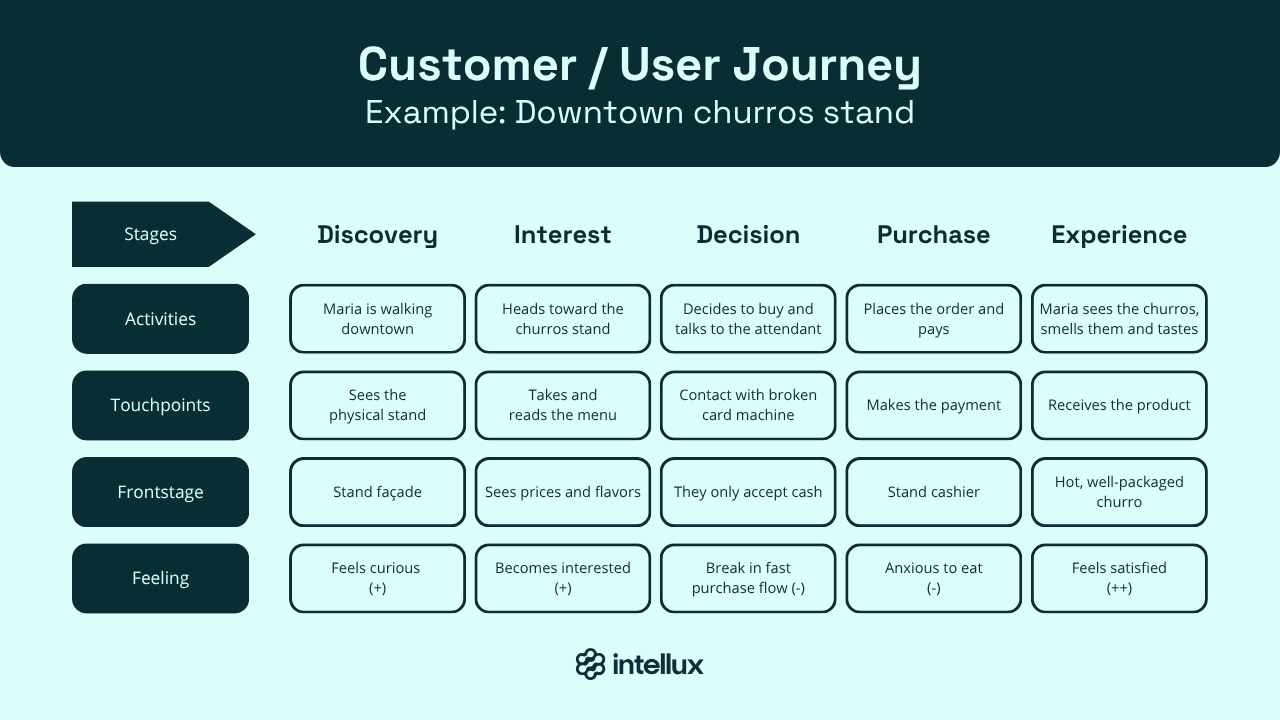
We brought a simplified example of the consumer journey using a churros stand scenario. As shown in the diagram on page 3, the journey is divided into stages such as awareness, interest, decision, purchase, and experience, along with elements like activities, touchpoints, frontstage, and feelings.
consumer-journey-example
Initially, Maria is walking through downtown and enters the awareness stage when she notices the stand, which sparks curiosity and interest. Then, she approaches, checks the menu, and considers buying, maintaining a positive perception during this first interaction. However, when she reaches the decision stage, a negative point appears when the payment machine is not working, breaking the natural flow of the purchase.

Despite this, Maria decides to continue the purchase using cash, places her order, and receives the product, which keeps the overall experience satisfactory. Even with another moment of tension related to waiting and anxiety during the process, the final result is positive because the product meets expectations. Still, the purchase flow is good but not ideal, since the ideal scenario would include a working payment machine and faster service.

How to create the consumer journey for my company?

Creating the consumer journey varies according to the type of company, the audience profile, and the business model, which requires a more strategic analysis before any structuring. Each segment has different behaviors, channels, and touchpoints, which prevents the application of a single model for all cases. Therefore, understanding how the customer interacts with the brand at each stage is the first step in building a coherent and effective journey.

In addition, the ideal approach is not to work with only one journey, but to develop multiple flows that represent different customer profiles or entry points into the business. This allows the analyst to clearly identify which journeys perform well and which contain bottlenecks that harm conversion. This comparative view enables more precise adjustments and more efficient strategic decisions over time.
Below, you will find guidelines based on the nature of your company, helping you better understand how to study and structure your consumer journey.

1. Consumer journey for physical stores

When structuring the consumer journey for physical stores, it is important to consider that the customer may arrive at the point of sale through different paths, such as social media, paid traffic, referrals, or even outdoor advertising. Each of these origins represents a distinct journey, with different perceptions and levels of interest throughout the process. Therefore, the first step is to map these entries separately, identifying how the consumer discovers the store and what influences their decision to visit.

Following the presented model, it is necessary to detail each stage based on activities, touchpoints, frontstage, and feelings. This means describing what the customer does, what they interact with, what the company visibly delivers, and how they feel at each phase. For example, a customer coming from Instagram may already have prior interest, while someone impacted by an outdoor ad may only be curious.

After building these variations, analysis becomes the most strategic part, allowing you to identify where the experience flows well and where disruptions occur. Observe friction points such as slow service, unclear pricing, or payment issues, as they directly impact conversion. With this, you can compare different journeys, understand which channels bring more qualified customers, and optimize the experience.

Practical tips:
  • Map at least three customer sources, social media, paid traffic, and street flow.
  • Describe each stage based on real customer actions.
  • Identify emotions such as curiosity, doubt, frustration, or satisfaction.
  • Observe in-person service carefully, as it is decisive for conversion.
  • Analyze bottlenecks in payment and waiting time.
  • Compare journeys to identify better-performing flows.
  • Continuously adjust based on real behavior.

2. Consumer journey for e-commerce

When structuring the consumer journey for e-commerce, consider that users can arrive through Google, social media, paid ads, or email marketing. Each entry point reflects a different level of purchase intent, influencing navigation behavior within the online store. Therefore, mapping these origins separately helps understand how users discover products and what drives them forward.

Following the model, detail activities such as clicks, page visits, interactions, and cart abandonment, along with touchpoints and feelings. For example, a user from a promotional ad may be closer to purchase, while someone at the top of the funnel is still exploring options.

Analysis helps identify bottlenecks such as slow pages, complex checkout, or lack of information. These issues generate doubt and abandonment, affecting conversion. By comparing journeys, you can optimize the process for speed, clarity, and trust.

Practical tips:
  • Map traffic sources clearly.
  • Analyze navigation behavior and engagement.
  • Monitor cart abandonment stages.
  • Ensure fast and responsive pages.
  • Simplify checkout processes.
  • Use social proof to build trust.
  • Compare journeys by channel.

3. Consumer journey for service companies

For service companies, the journey involves more analysis and trust, since the client evaluates delivery before hiring. Customers may come from social media, referrals, or search engines, each with different levels of maturity.

Map stages such as contact, meetings, proposals, and negotiation, along with feelings and perceptions. A referred client may trust faster, while a cold lead needs more validation.

Analysis identifies friction points such as slow response or unclear proposals. By comparing journeys, companies can improve flow and increase conversion.

Practical tips:
  • Map different customer origins.
  • Ensure fast and clear communication.
  • Anticipate common doubts.
  • Use testimonials and case studies.
  • Standardize proposals.
  • Reduce time between contact and closing.
  • Compare journeys for quality leads.

4. Consumer journey for software companies

For software companies, the journey is more rational and value-driven. Users may come from content, ads, or direct searches, each indicating a different level of awareness.

Map stages such as site visits, trial usage, onboarding, and support interactions. A trial user must quickly perceive value, while early-stage users compare options.

Analysis identifies issues such as poor onboarding or lack of support, which affect retention. By optimizing these points, companies improve activation and long-term engagement.

Practical tips:
  • Map acquisition channels.
  • Create clear onboarding processes.
  • Track usage behavior.
  • Simplify navigation.
  • Provide accessible support.
  • Use trials and demos.
  • Compare journeys for retention.

Conclusion

Finally, structuring and analyzing the consumer journey allows your company to gain control over each touchpoint and decision throughout the customer experience. With a clear view of each stage, it becomes easier to identify improvement opportunities, reduce bottlenecks, and increase conversion consistently.

In this context, working with Intellux can transform how your company executes digital marketing, expanding touchpoints and strengthening brand presence across multiple channels. With well-directed strategies, you simplify the consumer journey and create smoother experiences that guide customers more confidently toward purchase decisions.

If your goal is to scale results and make acquisition more predictable, Intellux can be the ideal partner to evolve your strategy. With more organization, data-driven actions, and digital presence, your company increases conversion potential and builds more efficient journeys for each type of customer.

Tags

strategic planning
Mobile CTA Background

Your business success can't wait any longer.