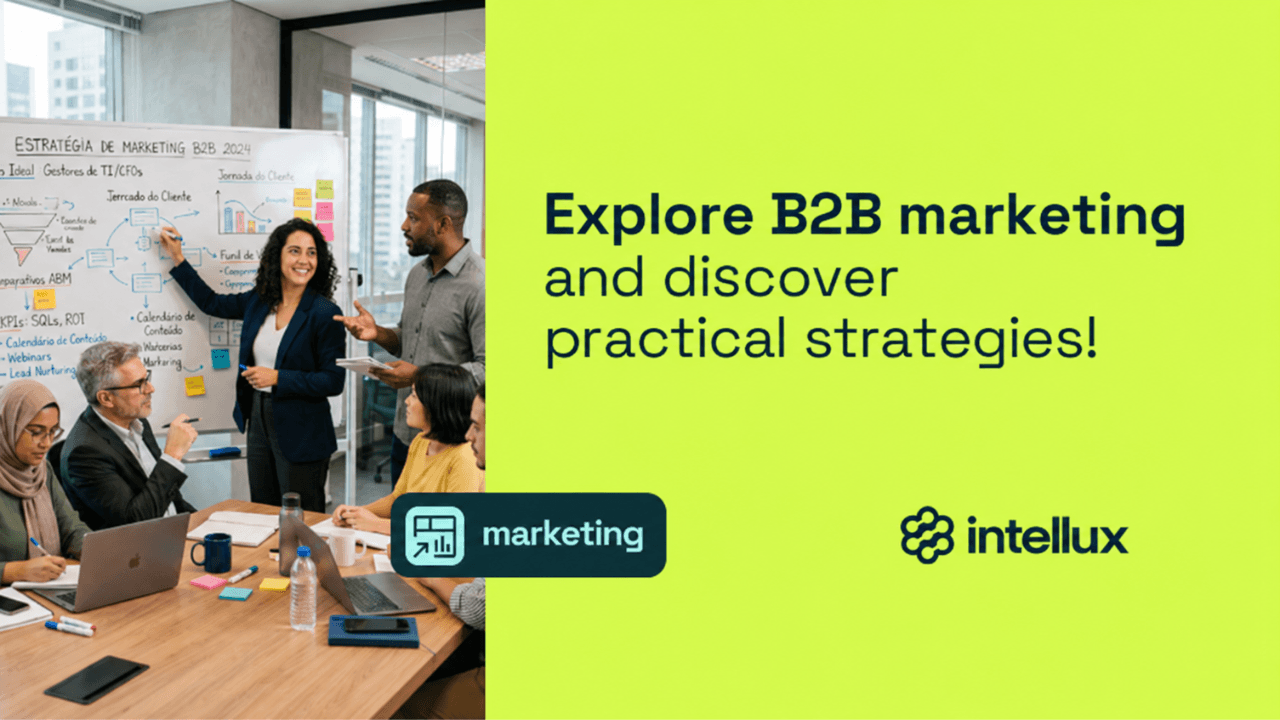
B2B marketing requires more than publishing disconnected content or waiting for a sale to happen on impulse. When a company sells to another company, the decision usually involves research, comparison, trust analysis and cost-benefit evaluation. That is why digital presence needs to be consistent, clear and designed to build relationships before the commercial approach.
Even so, many small businesses believe they need to hire an agency or build a large team to get started. In practice, the first step is to organize the basics, understand who the ideal customer is, create content with intention and maintain frequency on the right channels.
With tools like Intellux, this process becomes simpler, since the platform helps plan content, create copy, generate images and organize an editorial calendar with AI aligned with the brand’s identity.
What is B2B marketing and how can you work on it better in your company?
B2B marketing is the set of strategies used by companies that sell products or services to other companies. The acronym comes from business to business, meaning business carried out between companies. This model appears in areas such as business accounting, management software, consulting, industrial suppliers, technology companies, corporate service providers, agencies and freelancers that serve other businesses.
The main difference between B2B marketing and B2C marketing is in the decision-making process. In B2C, the purchase is usually more individual and may happen because of desire, immediate need or identification with the brand. In B2B, the decision tends to involve more research, comparison, trust, authority and proof of value, since the buyer needs to justify the choice to the company and evaluate impact, cost and return.
To work on B2B marketing better in your company, the path is to make communication more strategic. Instead of publishing only institutional posts or direct offers, it is worth creating content that answers questions, explains market problems, shows differentiators and helps the potential customer understand why your solution makes sense. This way, each channel, whether website, blog, Instagram or LinkedIn, starts to support the sales process with more clarity.
Influence of decision-making in B2B buying journeys
In B2B marketing,
the consumer’s buying journey can pass through different areas of the company before the final decision. This happens because hiring a product or service usually impacts budget, operation, team, processes and results. Among the main factors that influence the purchase are:
- Board decisions:
Evaluates whether the solution is aligned with the company’s strategic goals, whether it helps the business grow and whether it contributes to medium and long-term goals. - Financial decisions:
Analyzes investment, cost-benefit, return period, cash flow impact, predictability of expenses and comparison with other available alternatives. - Operational decisions:
Checks whether the solution makes the team’s routine easier, reduces rework, improves internal processes and solves practical day-to-day pains. - Logistics decisions:
Considers delivery deadlines, implementation, support, availability, integration with suppliers and impact on the execution of the company’s activities. - Technical decisions:
Evaluates compatibility with tools already used, security, ease of use, integrations, stability and the need for team training. - Commercial decisions:
Observes whether the solution can help sell more, improve service, generate leads, increase productivity or strengthen relationships with customers. - Marketing decisions:
Analyzes whether the solution strengthens the brand, improves communication, facilitates content production, increases digital presence and contributes to attracting qualified opportunities.
What is the difference between B2B and B2C marketing?
The main difference between B2B and B2C marketing is in the audience and the decision-making process. In B2C, communication usually speaks to final consumers and can explore desire, price, experience, identification with the brand and faster consumption. In B2B, communication needs to show value more clearly, explaining how the solution reduces costs, increases productivity, solves problems or improves the results of the buying company.
That is why B2B marketing usually requires more educational, strategic and trust-oriented content. The company that buys needs to understand the impact of the solution before making a decision, while in B2C the journey can be shorter and more emotional, depending on the product or service.
Practical comparison between B2B and B2C marketing:
Criterion: audience
- B2B: companies, managers, internal teams and decision-makers.
- B2C: final consumers, individuals and individual buyers.
Criterion: decision
- B2B: more rational, comparative and based on return, security and value.
- B2C: more emotional, immediate and influenced by desire, price or convenience.
Criterion: sales cycle
- B2B: generally longer, with research, meetings, analysis and internal approval.
- B2C: generally shorter, with fewer steps before purchase.
Criterion: content
- B2B: educational, technical, strategic and focused on solving problems.
- B2C: inspirational, promotional, informative or connected to consumer desire.
Criterion: relationship
- B2B: more important, because trust influences contracts, recurrence and referrals.
- B2C: varies according to the product, ticket size and the consumer’s relationship with the brand.
7 B2B marketing strategies to sell to other companies
To sell to other companies, B2B marketing needs to help the customer understand the problem, trust the solution and move safely toward the purchase. This does not mean creating difficult content or depending on a large team, but rather having clarity about who the company wants to attract, which questions it needs to answer and which channels make sense to generate commercial opportunities.
1. Define who your company’s ideal customer is
Before creating posts, campaigns or commercial materials, the company needs to know who it wants to attract. In B2B marketing, this means defining the ICP, or ideal customer profile. This profile brings together characteristics of the companies that are most likely to hire, remain as customers and generate good results.
To define this ideal customer, evaluate points such as business segment, company size, location, decision-maker’s role, available budget, most frequent pains, purchase objections and the moment when the solution is usually sought. A financial consulting firm for companies, for example, can target small businesses that grew quickly and now need to organize cash flow, costs and projections.
With this information well defined, communication stops being generic. It becomes easier to create content, campaigns and commercial arguments that speak to real problems. It also becomes simpler to use AI in content creation, since the tool starts working with clearer context, audience and intention.
2. Create content for each stage of the decision
Not all B2B content needs to sell directly. In many cases, the customer’s first contact with the brand happens when they are still trying to understand a problem. That is why the company needs to produce content for different stages of the decision, from discovery to the purchase moment.
At the top of the funnel, it is worth talking about common problems, tips, trends, mistakes and initial questions. In the middle of the funnel, content can bring comparisons, guides, checklists, solutions and more in-depth explanations. At the bottom of the funnel, materials such as case studies, proof, differentiators, demonstrations, behind-the-scenes content and materials that show why the company is a good choice come in.
This division helps create a more natural journey. A potential customer can discover the brand through an educational post, then read a more complete article, follow the company on social media and only then request a quote or start a commercial conversation. That is why content needs to guide the reader, not just appear in front of them.
3. Use LinkedIn and Instagram with different roles
In B2B marketing,
LinkedIn and Instagram can work together, but they do not need to serve the same function. LinkedIn usually works well for authority, networking, professional relationships and B2B prospecting. It is a useful channel to talk to decision-makers, share market learnings and reinforce the company’s view of its own sector.
Instagram, on the other hand, can strengthen presence, behind-the-scenes content, social proof, routine, culture, brand perception and closer relationships. Even when the sale happens in a corporate environment, the decision-maker still researches, compares and observes how the company communicates. A well-managed profile can help convey trust.
The main point is to maintain consistency across channels. The language does not need to be identical in all of them, but it must respect the same brand identity. When the company has clarity about tone of voice, audience and value proposition, it becomes easier to adapt the message to each channel without seeming disconnected.
4. Show authority without depending on complex content
Many small businesses stop producing B2B content because they believe they need to publish long analyses, technical materials or complete reports all the time. In practice, authority can also be built with simple content, as long as it is useful, clear and connected to the customer’s questions.
A good way to start is to turn frequently asked questions into posts. It is also worth explaining processes, showing before and after examples, commenting on sector trends, sharing strategic behind-the-scenes content, creating educational carousels and turning commercial objections into content. If a customer always asks how long it takes to see results, that topic can become a post, an article or a short video script.
This type of content helps show knowledge without making the team’s routine more complicated. With Intellux, these ideas can be organized in an editorial calendar and transformed into copy and posts with AI, respecting the brand’s tone of voice and identity.
5. Organize a B2B editorial calendar
B2B marketing depends on consistency. Without an editorial calendar, the company tends to post only when there is spare time, repeat topics, forget important dates or talk only about the product. The result is an irregular digital presence, which makes it harder to build trust.
An editorial calendar helps distribute topics throughout the week and maintain balance between education, authority, social proof and offer. A simple example for B2B companies could be:
- Monday: customer pain.
- Tuesday: practical tip.
- Wednesday: authority or behind-the-scenes content.
- Thursday: social proof.
- Friday: offer, invitation or CTA.
This model prevents communication from becoming repetitive and helps the team produce with more direction. In Intellux, it is possible to create an editorial calendar with AI, generate copy, create images and organize upcoming content in a single platform, without depending on scattered spreadsheets or several different tools.
6. Use AI to accelerate, but not to standardize your communication
AI can help a lot in B2B content production, especially for small teams, freelancers, social media professionals and companies that need to maintain frequency without increasing operational workload. It can support the creation of ideas, captions, images, calendars, post variations and campaigns.
The care point is not to turn communication into something generic. In B2B marketing, content needs to reflect the company’s positioning, the audience it serves, the pains it solves and the way the brand communicates. If AI does not receive context, it tends to produce texts similar to those of any other company.
That is why the ideal approach is to use AI with information about the business, tone of voice, audience, goals and brand manual. In Intellux, AI works connected to the customer’s brand manual, which helps create content that is more coherent with the company’s identity and more useful for those who are making a purchase decision.
7. Turn content into commercial conversations
B2B content needs to generate relationships, but it also needs to open paths to sales. That is why each publication should have a clear next step. This next step can vary according to the customer’s moment and the objective of the content.
In more educational content, the CTA can invite the person to read another article, download a material, follow the company or save the post. In content closer to the decision, the CTA can direct the person to a conversation, quote, demonstration, registration page, solution test or contact with the sales team.
Some CTA examples for B2B marketing are:
- Talk to our team.
- Request a quote.
- Download the complete material.
- Send a message to understand the solution.
- Create your account.
- Schedule a demonstration.
- Get to know the solution.
The most important thing is to avoid content with no direction. If the company wants to generate commercial opportunities, it needs to guide the reader to the next stage. In the case of Intellux, this means showing how planning, copy, image, calendar and scheduling can leave improvisation behind and become a simpler routine for those who need to sell to other companies.
Conclusion
B2B marketing does not need to start with a complex structure, large campaigns or a full team. For many small businesses, the first step forward is to organize communication, understand who the ideal customer is and maintain a consistent presence on the right channels.
With clarity and consistency, smaller companies can also compete for attention, build authority and generate commercial opportunities. Content should educate, answer questions, show value and open space for conversations with customers who are still researching, comparing and evaluating solutions.
Intellux helps make this process simpler, connecting planning, content creation, image generation, AI copywriting and post scheduling in a more organized routine aligned with the brand’s identity.
Want to structure your company’s B2B marketing with more organization and less rework? Create your Intellux account and use AI to plan content, generate copy, create images and schedule publications based on your brand’s identity.