SEO



El fine-tuning representa directamente el avance de la inteligencia artificial, cambiando la forma en que las marcas crean contenido, atienden a sus clientes y analizan datos. En este contexto, esta tecnología se ha convertido en una de las estrategias más comentadas, ya que permite adaptar modelos de IA a necesidades más específicas.
En marketing, el fine-tuning puede aportar beneficios reales en productividad, personalización y consistencia. Sin embargo, también genera importantes debates sobre derechos de autor, reconocimiento de creadores y disminución del tráfico hacia sitios web y blogs que sirven como fuentes de información.
Fine-tuning significa "ajuste fino". En la práctica, una empresa parte de un modelo de IA previamente entrenado y lo adapta utilizando un conjunto de datos específico.
En lugar de utilizar una IA genérica, una marca puede entrenar el modelo con:
De esta manera, la IA responde de forma más alineada con el estilo de la marca, su público objetivo y sus objetivos comerciales.
Aunque ambos conceptos están relacionados, no significan lo mismo. El machine learning, o aprendizaje automático, es una rama de la inteligencia artificial que permite que los sistemas aprendan patrones a partir de datos para realizar predicciones, clasificaciones o tomar decisiones.
El fine-tuning es una técnica que forma parte de este universo. En lugar de crear un modelo desde cero, aprovecha un modelo ya entrenado y realiza ajustes para que ejecute determinadas tareas con mayor precisión o siga comportamientos específicos.
En el machine learning tradicional, los desarrolladores alimentan algoritmos con grandes volúmenes de datos para que aprendan patrones y desarrollen su capacidad de respuesta con el tiempo.
Algunos ejemplos comunes incluyen:
Este entrenamiento suele requerir grandes cantidades de datos, infraestructura informática robusta y un proceso de desarrollo más complejo.
El fine-tuning ocurre en una etapa posterior al machine learning. El modelo ya posee conocimientos generales adquiridos durante su entrenamiento inicial. A partir de ahí, una empresa u organización proporciona información adicional para especializarlo en un contexto determinado.
Por ejemplo, una empresa puede realizar fine-tuning en un modelo de IA utilizando:
De esta forma, la IA genera respuestas más alineadas con la realidad del negocio sin necesidad de entrenar un modelo desde cero.
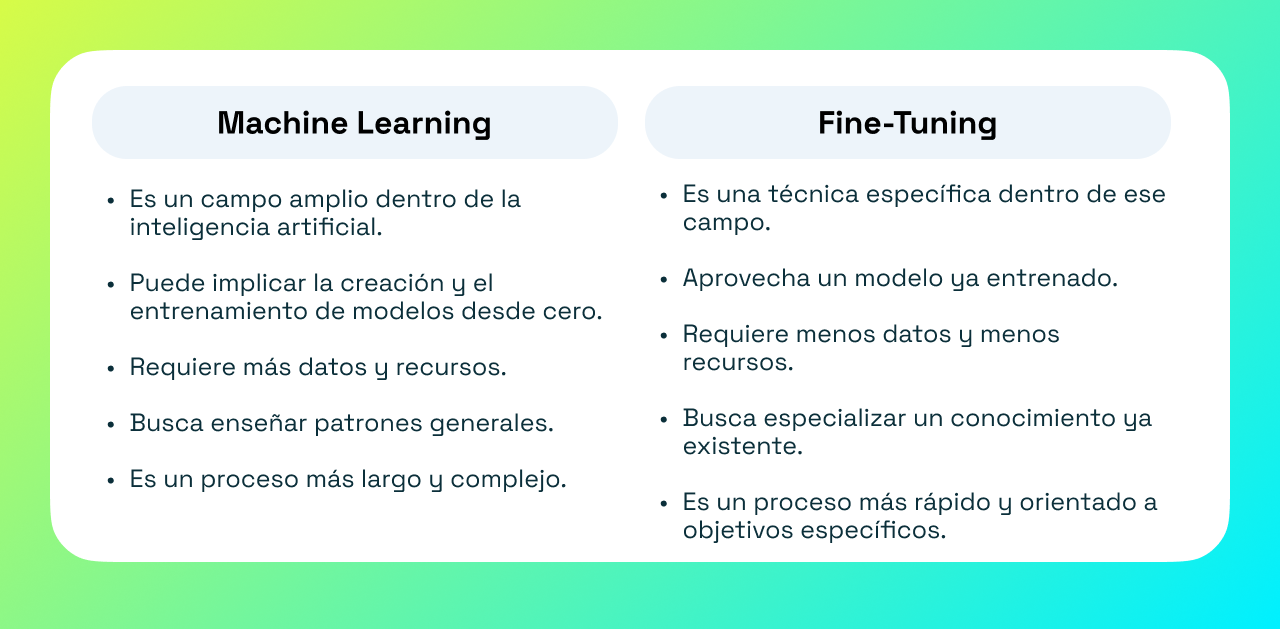
Para el marketing, esta diferencia es importante porque pocas empresas cuentan con los recursos necesarios para desarrollar modelos propios de machine learning. Por el contrario, el fine-tuning permite adaptar herramientas de IA existentes a necesidades específicas, haciendo que esta tecnología sea más accesible para marcas de distintos tamaños.
El fine-tuning puede ser muy positivo cuando se utiliza estratégicamente. Reduce el tiempo dedicado a tareas repetitivas y mejora la calidad de las respuestas en contextos específicos.
Para un equipo de marketing, esto significa producir contenidos más alineados, crear campañas con mayor agilidad y mantener una comunicación más consistente entre diferentes canales.
Una marca con un tono de voz bien definido puede utilizar el fine-tuning para mantener ese estándar en blogs, redes sociales, correos electrónicos y atención al cliente.
De este modo, la IA comprende mejor qué términos utilizar, cuáles evitar y cómo estructurar los mensajes. Esto ayuda a reducir revisiones y mejora la percepción de profesionalismo.
Otro beneficio importante es la personalización. Con datos bien organizados, la IA puede generar respuestas más cercanas a las necesidades de cada audiencia.
Por ejemplo, una tienda online puede adaptar recomendaciones, descripciones y mensajes postventa según el comportamiento de sus clientes. Como resultado, el marketing se vuelve más relevante y menos genérico.
En el marketing digital, el fine-tuning puede cambiar la forma en que las empresas crean contenido y se relacionan con su audiencia. Entre los principales impactos se encuentran:

Además, los equipos más pequeños pueden competir con empresas más grandes, ya que la IA ayuda a automatizar parte del trabajo creativo y operativo. Sin embargo, esto no elimina la importancia de la estrategia humana. La IA puede acelerar procesos, pero aún necesita dirección, revisión y criterios claros.
A pesar de sus beneficios, el fine-tuning también genera preocupaciones. Una de las principales está relacionada con el uso de contenidos producidos por autores, periodistas, blogueros y especialistas sin el debido reconocimiento. Muchos modelos de IA aprenden a partir de textos disponibles en internet.
El problema surge cuando estos contenidos ayudan a entrenar sistemas que posteriormente entregan respuestas completas a los usuarios sin dirigirlos a la fuente original. Como consecuencia, el autor puede perder dos elementos fundamentales: reconocimiento y tráfico.
Antes, cuando una persona buscaba una respuesta en Google, era habitual que visitara un blog, leyera el contenido y conociera a la empresa o al autor detrás de esa información.
Ahora, con las respuestas generadas por IA directamente en los motores de búsqueda o asistentes virtuales, los usuarios pueden obtener la información sin visitar el sitio web original.
Esto afecta directamente a:
Por lo tanto, aunque el contenido continúe utilizándose como fuente de conocimiento, el clic puede dejar de producirse. Para quienes invierten tiempo y recursos en la creación de contenido, este cambio representa un desafío importante.
El SEO tiende a volverse más competitivo. Si los usuarios reciben respuestas listas para usar mediante IA, los sitios web deberán ofrecer algo más que información básica.
Esto significa que los contenidos genéricos, superficiales o repetitivos pueden perder relevancia con mayor rapidez. Por otro lado, los materiales originales, completos y bien posicionados aún tienen espacio para destacar.
La tendencia indica que las marcas invertirán más en:
Los textos que incluyen opiniones, análisis propios, ejemplos reales y experiencia práctica adquieren mayor valor. Después de todo, la IA puede resumir información, pero sigue dependiendo de fuentes confiables para construir buenas respuestas.
Cuando un usuario reconoce una marca como referente, es más probable que la busque directamente. Por eso, el branding y el SEO deben avanzar juntos.
Investigaciones propias, casos de estudio, informes y análisis internos pueden diferenciar a una empresa en un entorno donde los contenidos son cada vez más similares.
El avance de las respuestas generadas por IA, como los AI Overviews de Google y otros sistemas generativos, ha generado una nueva preocupación para autores, blogueros y medios digitales.
Después de todo, gran parte de estos contenidos puede utilizarse como base para respuestas automáticas sin generar el mismo volumen de clics hacia las páginas originales.
Este escenario crea un conflicto importante. Por un lado, el usuario recibe respuestas rápidas y prácticas. Por otro, quienes produjeron el contenido que alimentó esas respuestas pueden perder visibilidad, tráfico y reconocimiento.
Los datos de un análisis realizado por Ahrefs sobre 300.000 palabras clave muestran que el CTR promedio de la posición número uno cayó de una previsión del 3,7 % a un resultado real del 1,6 % en diciembre de 2025. Esto representa una disminución del 58 % en el volumen de clics.
Además, el estudio indica que las consultas con AI Overviews experimentaron una caída del CTR orgánico del 1,76 % al 0,61 %. En el tráfico de pago, la reducción también fue significativa, pasando del 19,7 % al 6,34 %.
La IA puede organizar información, resumir contenidos y facilitar la experiencia de búsqueda. Sin embargo, cuando ofrece respuestas completas sin valorar adecuadamente la fuente original, el ecosistema de contenidos pierde equilibrio.
Blogs, periodistas, especialistas y empresas invierten tiempo, investigación y estrategia para producir materiales útiles. Si esos contenidos alimentan sistemas de IA pero dejan de recibir reconocimiento, tráfico o algún tipo de retorno, la producción de contenido original puede volverse menos sostenible.
Otro dato relevante muestra que las marcas citadas en AI Overviews recibieron un 35 % más de clics orgánicos y un 91 % más de clics de pago que aquellas que no fueron citadas.
Esto refuerza una realidad importante: producir contenido ya no es suficiente. También será necesario construir autoridad para convertirse en una fuente referenciada por las respuestas generadas por IA.
Como resultado, el SEO depende cada vez más de la credibilidad, la reputación y la presencia de marca.
Cuando la IA ignora a los creadores originales, el impacto va más allá de la pérdida de tráfico.
El mercado podría enfrentar una reducción en la producción de contenidos especializados y de alta calidad, ya que muchos autores dependen de visitas, publicidad, leads y conversiones para mantener sus proyectos activos.
Por ello, el debate sobre el fine-tuning, los AI Overviews y otras inteligencias artificiales debe responder una pregunta fundamental: ¿cómo puede evolucionar la tecnología sin desvalorizar a quienes producen el conocimiento que utiliza?
Para el marketing, esta discusión es determinante. Las marcas que invierten en contenido deben seguir de cerca los cambios en las búsquedas, fortalecer su autoridad y defender prácticas más transparentes en el uso de la inteligencia artificial.
Recientemente, el Reino Unido abrió el debate sobre la necesidad de regular el uso de la inteligencia artificial por parte de grandes plataformas tecnológicas, incluido Google.
La discusión involucra temas como la transparencia, el uso de contenidos de terceros y el impacto sobre las marcas que dependen del SEO.
Este movimiento demuestra que gobiernos y organismos reguladores ya están observando cómo la IA puede transformar la relación entre los motores de búsqueda, los productores de contenido y los usuarios.
Para comprender mejor este escenario, consulta el artículo relacionado: "¿La regulación de la IA en el Reino Unido puede afectar a las marcas internacionales?".
El fine-tuning puede ser una herramienta muy poderosa, pero necesita límites claros. Las empresas que utilizan IA en marketing deben preocuparse por la ética, la transparencia y la calidad de la información.
Entre las buenas prácticas destacan:
De esta forma, la tecnología deja de ser únicamente una herramienta para producir más rápido y se convierte en una aliada para crear contenidos de mayor calidad.
El fine-tuning de las IA representa una gran oportunidad para el marketing. Ayuda a las empresas a personalizar campañas, mejorar la atención al cliente, acelerar procesos y mantener una comunicación más consistente.
Al mismo tiempo, esta evolución exige precaución.
Cuando los contenidos creados por autores y blogs alimentan sistemas de IA sin generar reconocimiento o tráfico hacia las fuentes originales, el mercado necesita debatir nuevas formas de atribución, compensación y transparencia.
En última instancia, el impacto del fine-tuning depende de cómo se utilice. Con estrategia y responsabilidad, puede fortalecer a las marcas. Sin criterios claros, puede ampliar problemas que ya existen en el ecosistema digital.
Continúa explorando contenidos relacionados que pueden interesarte