Marketing strategy


Creating videos for a small business doesn't have to mean producing elaborate commercials or spending hours trying to come up with a completely new idea for every post. In practice, a content strategy can work better when a company finds a few formats that match its communication style and repeats them with different topics.
This makes it possible to turn content creation into a routine. A business owner can have one format for entertainment, another for showing behind the scenes, another for answering questions, and so on. The idea isn't simply to repeat videos, but to create recognizable structures that make both production and audience engagement easier.
Content creation isn't a one-size-fits-all formula, but many techniques can be adapted to different niches, since every business has different needs and a different target audience. A clinic may need to convey expertise and trust, while a burger restaurant may have more freedom to produce skits and joke about common customer situations.
Before choosing a video format, consider the company's positioning, the product being sold, who will appear on camera, and the type of relationship the brand wants to build with its audience.
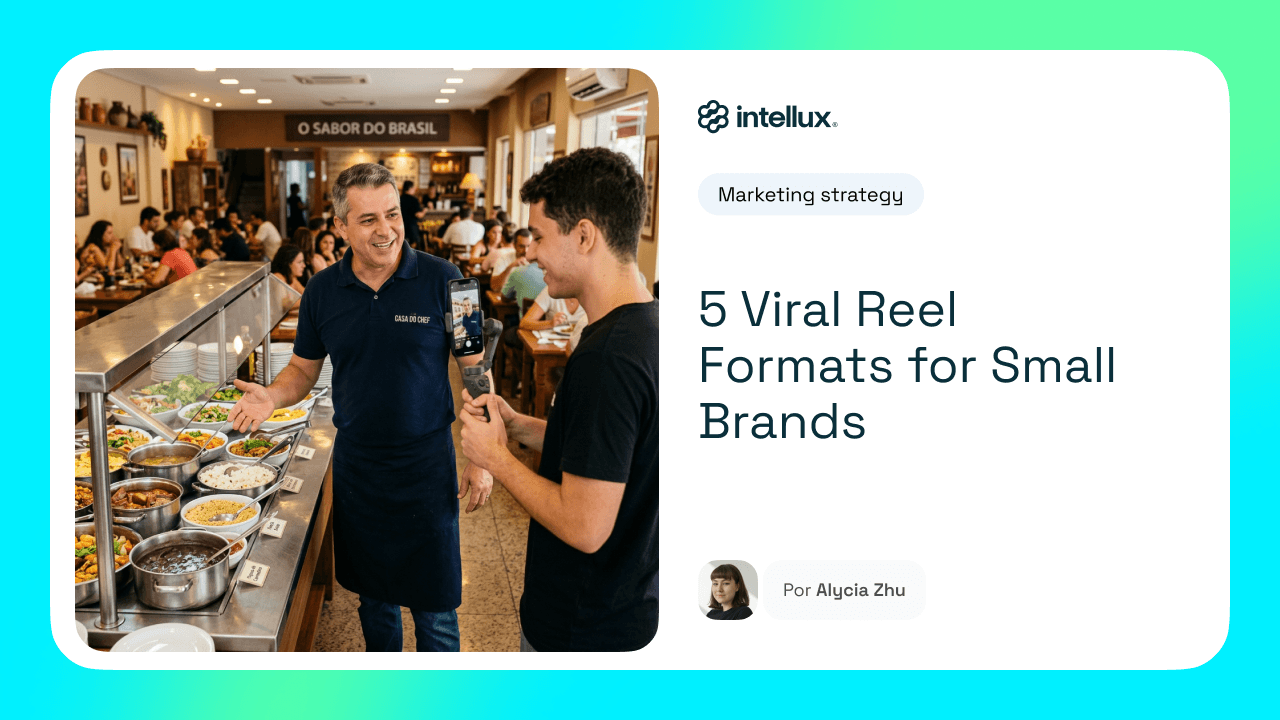
Below are five video ideas that can become recurring formats for small businesses.
A skit turns common situations within a business into short comedy scenes. These are usually quick videos built around a problem, behavior, or conversation that the audience recognizes.
A restaurant, for example, could act out the customer who always asks for something that isn't on the menu. A store can portray different types of shoppers. A professional can play both themselves and their clients.
This format works because people don't go on social media only to look for products. They also want entertainment. When a brand can become part of that experience without turning every video into a direct advertisement, the content has a greater chance of being watched and shared.
An interesting example is the "The Pastelaria" series, created by Elson Pastel. This successful case drew inspiration from The Office, a sitcom widely known among younger audiences, and attracted a large following by using a similar style of humor. Suzane Iano was the creative mind behind the project, showing that even pop culture, which many people consider saturated, can still provide creative inspiration.
The skit format tends to work best for companies whose communication allows for a more informal approach, such as:
restaurants;
coffee shops;
retail stores;
hair salons;
auto repair shops;
gyms;
small e-commerce businesses;
service businesses with a relaxed brand personality.
However, it's important to assess whether this type of communication matches the positioning customers expect from the brand.
A company that strongly depends on an institutional image may need to use humor more carefully. That doesn't mean professionals who rely on authority and expertise can't produce skits.
Mari Krüger uses skits and humorous situations to turn everyday topics into quick and easy-to-consume content. Her digital presence shows how a creator can use characters, exaggeration, and relatable situations without relying on complex production.
For small businesses, the main takeaway is how the scenes are structured. Common situations between customers and employees can become short scripts that create identification while allowing the product or service to appear naturally within the story.
Dr. Ricardo Kores shows that the skit format can also work for professionals who need to build authority. His content combines health information, everyday situations, humor, and a provocative communication style.
In this case, entertainment becomes an entry point for topics that could otherwise be discussed in a much more technical way. It's an interesting reference for professionals who want to use humor without giving up an authority-based positioning.
Dr. Glaucomflecken is a character created by American ophthalmologist Will Flanary. His videos use skits to portray doctors from different specialties, patients, and situations within the healthcare system.
One of the most distinctive elements is his use of recurring characters. Small businesses can adapt this by creating recognizable personas such as "the customer in a hurry," "the customer who Googled everything," or even different members of the team.
Bistro Huddy is a series created by Drew Talbert based on situations he experienced while working in the restaurant industry. In the videos, he plays servers, cooks, managers, customers, and other characters inside a fictional restaurant.
The project is a useful reference for restaurants, bars, coffee shops, and other businesses that have frequent contact with customers. Common service situations can generate dozens of scripts without requiring the product to appear as part of a traditional advertisement.
Big Lee's BBQ uses owner Rashad Jones' personality and situations related to the restaurant as part of the company's social media presence.
It's an interesting reference for founders who want to become one of the characters of their own brand. Instead of maintaining a distant institutional voice, the owner participates in the videos and helps give the business a recognizable personality.
→ "When [type of customer] asks for [common business situation]..."
From there, the business owner acts out the situation by exaggerating behaviors the audience recognizes.
Example for a coffee shop:
→ "When the customer says they don't like strong coffee and orders a triple espresso."
The product appears within the story rather than being the explicit reason for the video.
Another option is to move away from the idea of completely independent videos and start producing episodes.
In this format, each post presents a small part of a larger story. There may be a goal, a problem, a transformation, or simply characters and situations that continue from one video to the next.
The result is closer to the structure of a TV show.
Instead of thinking only, "What should we post today?", the company starts thinking, "What happens in the next episode?" This shift matters because it creates anticipation.
When users want to discover the result of a renovation, follow the opening of a new store, find out whether a project worked, or see the next problem faced by the business owner, they have a reason to return to the profile.
The "Jhenny, a obra" project turns a renovation into a narrative the audience can follow. Instead of showing only the final result, events, decisions, and challenges become episodes.
This structure can be adapted by companies going through some type of transformation. Moving to a new location, launching a product, renovating, expanding, or preparing for an event can provide enough material for an entire season of content.
Baudelaire used routine-based content to encourage audiences to follow what was happening within the company and with the people behind it.
The key difference is turning ordinary business situations into chapters of a larger story. Consumers begin to follow the process and become familiar with the founders before they even consider making a purchase.
Alexandra Gater produces room transformation series, with a strong focus on small-space projects. Each renovation has a beginning, development, and final result.
For architects, designers, carpenters, and renovation companies, the format demonstrates how a client project can become a story. The briefing, material selection, problems encountered, and final result can all be distributed across different videos.
Lone Fox, a project created by Drew Scott, turns renovations, interior design, and personal projects into serialized content.
Some projects are followed across several videos, allowing viewers to see each stage before the final result. The format can be adapted for any business with processes that have a clear beginning, middle, and end.
"Day X of trying to [goal]."
"Episode X: [name of the series]."
The ending should leave an open question that encourages viewers to watch the next episode.
Example:
"The furniture for our new store finally arrived today. The problem is, we discovered something that could delay the entire opening."
The continuation becomes a reason to follow the profile.
Making-of content shares some characteristics with the previous format, but there is an important difference. In the TV show style, there is greater concern with narrative, episodes, and continuity. In making-of content, the main value comes precisely from the lack of elaborate production.
The camera simply follows what is already happening.
It could be a real estate agent visiting a property before the client, a baker preparing the morning's orders, an architect checking a construction site, or a business owner organizing a new space.
Jully turned the renovation of an abandoned house into content by showing decisions, challenges, financing, problems encountered, and progress on the project.
The strength of this format comes from not presenting a perfect version of the process. The audience follows what is actually happening, including moments when things don't go according to plan.
Lone Fox also works as a reference for making-of content because Drew Scott records real stages of renovations, material choices, visits, tests, and project execution.
The difference compared with the TV show style is the approach. A video can simply follow what happened that day without needing to build a complete episode around it.
Mississippi Candle Company uses its daily business routine and production process as part of its digital communication.
For handmade businesses, this type of content makes it possible to show work that usually happens away from the customer's view. Production, organization, order preparation, and everyday events can all become content topics.
Angel Baked NYC uses cookie production and founder Abbey Kowalec's daily routine as content.
It's an interesting reference for bakers and small businesses because it shows how an everyday activity can become the script itself. Instead of stopping work to produce an elaborate video, the camera follows what would already be happening.
It can be particularly useful for:
architects;
engineers;
real estate agents;
construction companies;
bakers;
restaurants;
artisans;
photographers;
production companies;
retail stores;
auto repair shops;
event businesses;
companies that manufacture their own products.
The main advantage is that the topic already exists, and the business routine itself provides the subjects that generate the most curiosity about how the company works.
"Come with me while I [real activity]."
Examples:
"Come with me to evaluate an apartment before showing it to the client."
"We have 47 orders to ship today, and I'm going to show you how we do it."
"This is the problem we found at the construction site today."
The camera works almost like a companion following the business owner throughout the process.
Not every company needs to produce humor or turn its daily routine into entertainment.
In many industries, providing information is one of the main ways to capture attention.
This is common among lawyers, architects, consultants, beauty professionals, hair salons, clinics, and businesses that sell more complex services.
Authority content answers questions, explains concepts, and helps consumers better understand what they are considering hiring.
However, the logic behind this content needs to be well defined.
For service-based entrepreneurs, there is a difference between educating an audience and teaching the entire operational process. The goal doesn't need to be turning followers into specialists. An architect can explain why a certain decision increases the cost of a renovation without teaching every step required to complete an architectural project.
A lawyer can explain how a certain process works without replacing an individual legal analysis. A hairstylist can show why a particular color treatment produced a poor result without turning every post into a complete technical course. As a result, consumers arrive better prepared for a meeting, quote, or consultation.
They understand the problem, know part of the process, and can ask better questions, while still recognizing the value of the professional.
Juba Colorida uses knowledge about hair, color, and procedures as raw material for content.
This model works because questions that would normally come up during an appointment can be answered before the first contact even happens. For salons and beauty professionals, problems, myths, mistakes, and care tips provide a constant source of content ideas.
Reger Arquitetura represents a format architects and firms can use to explain decisions that are often invisible to the people hiring the service.
Content can address renovation mistakes, material selection, room layouts, costs, and design decisions. The company demonstrates expertise without turning every post into an architecture class.
Miriane Ferreira uses professional knowledge as a central part of her content, showing how technical issues can be translated into language consumers can easily understand.
This type of profile is a useful reference for professionals who want to better prepare clients before an appointment by explaining procedures, expectations, and aftercare.
Law By Mike is a project by American attorney Mike Mandell. His videos turn legal situations into quick explanations, often starting with questions that spark curiosity.
For lawyers, accountants, consultants, and professionals who provide complex services, the lesson is to identify questions the audience genuinely has and turn them into easy-to-understand content.
Brad Mondo built his digital presence by discussing haircuts, coloring, transformations, and common hair mistakes.
One of his recurring formats involves analyzing situations and explaining why a particular result occurred. Small businesses can adapt this logic by analyzing common problems in their own industry and presenting a professional perspective.
The B1M turns architecture, engineering, construction, and major projects into content that can be understood by people who don't necessarily work in those industries.
The main lesson for small businesses is simplification. A topic can be technical without the video needing to use difficult language. Professionals demonstrate that they understand a subject precisely because they can explain it clearly.
"Before hiring [service], you need to know this."
"3 things I would check before..."
"This mistake could increase the cost of your..."
"Why do professionals do X instead of Y?"
"If you're thinking about doing X, watch out for this."
These hooks are based on questions that would normally come up during a sales meeting.
For some businesses, talking isn't necessary, because the product itself can carry the video and encourage engagement. This is where conceptual content comes in, with videos focused on visuals, texture, movement, sounds, and details. This format appears frequently among brands selling:
candles;
ceramics;
stationery;
baked goods;
jewelry;
cosmetics;
handmade products;
home decor;
clothing;
accessories;
home products.
Audio and visual ASMR can be part of this strategy. Sounds such as packages being opened, paper being cut, chocolate being broken, a candle being lit, or ceramics being shaped can turn the product itself into a visual and auditory stimulus.
Studies on ASMR suggest that combining visuals and sound can intensify the experience. A 2026 study published in Frontiers in Psychology indicates that audiovisual stimuli can produce stronger ASMR sensations than sound-only stimuli, particularly when what viewers see corresponds to what they hear.
Profiles such as Lawa Candle, @sumlilthings, and @akemibakes operate within this visual universe. The content doesn't need to explain every feature of the product. It sells a feeling:
A candle can represent a peaceful evening at home.
A ceramic piece can represent a breakfast table.
Stationery can represent an organized routine.
Packaging can represent the experience of receiving an order.
That's why this format can work for both affordable and luxury products. What changes is the atmosphere created:
A premium product can emphasize exclusivity, finishing, and details.
A more affordable product can sell the idea of small, attainable pleasures in everyday life.
Among international references, Royalty Soaps turns the soap-making process into part of its content. The brand shows its products being made on social media and has even published videos entirely built around ASMR during production.
Elyse Breanne Design is another useful reference for stationery and lifestyle products. The company started as a small Etsy shop and grew from the founder's artwork.
Mississippi Candle Company provides a direct reference for candle businesses and handmade brands by combining product, process, and the founder's story.
Here, the hook can be visual rather than spoken. Some possibilities include:
"POV: your order just arrived."
"Pack an order with me."
"From a block of clay to the finished product."
"A morning using our products."
"Making the candle you ordered."
"Pack an order with me."
"Working in silence."
You can also simply begin with the most satisfying sound or movement in the process and reveal the product a few seconds later.
You don't need to choose only one format. A company can combine different styles within the same strategy. Testing different formats also helps you better understand your own audience and analyze how the profile performs.
An architect, for example, can publish authority content explaining design decisions, produce making-of videos during construction site visits, and create a series following a specific renovation.
A bakery can post skits during the week, show behind-the-scenes production on weekends, and use conceptual videos to introduce new products.
The most important thing is to find repeatable video formats, hooks that are easy to replicate, and filming and editing styles that are sustainable in the long term. This helps ensure that consistency won't become a problem over time.
When every post depends on a completely new idea, content creation becomes exhausting. When recurring series and formats are already defined, the business owner only needs to find a new topic to place within a structure that already works.
A practical way to organize the strategy is to turn each style into a recurring series.
For example:
Authority content.
Skits.
TV show style.
Making-of.
Conceptual content.
This way, five formats can generate dozens of videos over the course of several months.
Having good ideas helps, but producing content consistently also requires organization.
A small business usually needs to divide its attention between customer service, sales, operations, finances, and many other activities. That's why recording and publishing everything on the same day isn't always the best solution.
One alternative is to set aside a period to record several pieces of content, prepare the posts in advance, and organize a calendar.
With Intellux, you can schedule posts in advance and organize your publishing routine. This allows the company to use quieter periods to record content, prepare posts without rushing, and keep its social media channels updated without having to scramble every day to decide what to publish.
Continue exploring related content that might interest you