Marketing strategy


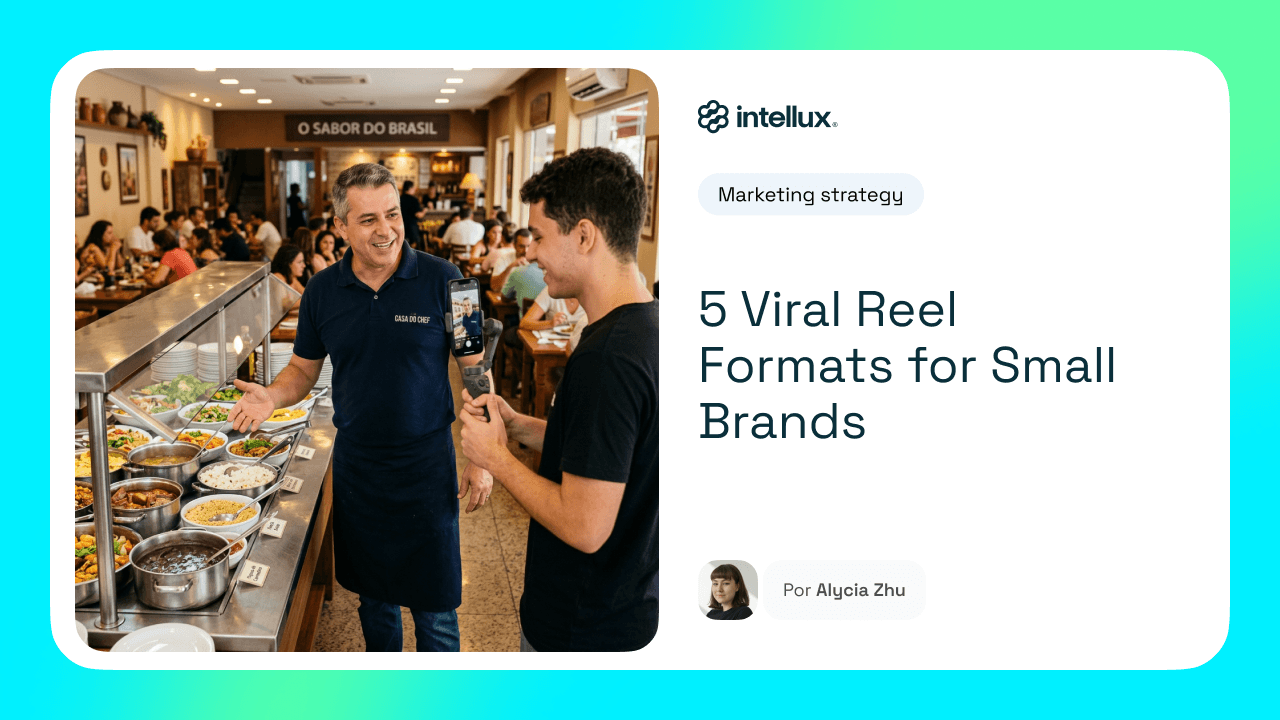
Producing Reels does not require professional cameras, large teams, or hours of editing. On the contrary, a simple idea presented clearly can reach thousands of people and introduce a small business to new customers.
Moreover, the format itself favors account discovery. According to a Buffer analysis of more than 52 million posts, Reels reached, on average, 36% more people than carousels. However, carousels generated approximately 12% more engagement. Read the full Buffer analysis.
Therefore, small business owners need to use each type of content for a specific purpose. While a Reel attracts new people, other formats explain the service, answer questions, and show why the business deserves their trust.
Below, you will find five viral Reel formats that are easy to adapt. In addition, each idea includes a real post that surpassed 1 million views.
“People are more interested in video because it is just more engaging.”
Adam Mosseri, Head of Instagram. Source: Buffer
First, Reels can reach people who do not follow the company yet. Therefore, a post recorded inside a restaurant, salon, or office can appear to potential customers in the surrounding area.
Moreover, audiences can easily share short videos. According to Meta, people reshare Reels more than 4.5 billion times every day across its platforms. Read Meta’s official announcement.
However, a view does not automatically represent a sale. Consequently, the profile must be ready to receive the people attracted by the video.
Therefore, a small business should combine three types of content:
| Stage | Objective | Recommended content | Next action |
|---|---|---|---|
| Discovery | Reach new people | Short Reels, trends, and transformations | Visit the profile |
| Trust | Demonstrate knowledge and quality | Carousels, behind-the-scenes content, testimonials, and answers | Follow or send a question |
| Conversion | Make hiring or purchasing easier | Services, prices, business hours, menus, and offers | Book, order, or purchase |
Therefore, the Reel opens the door. However, the profile’s organization, the quality of the remaining content, and the clarity of the offer encourage visitors to step inside.
The before-and-after format works because it presents a change that people can understand immediately. Therefore, the audience does not need to watch a long explanation to understand the benefit offered.
Moreover, the transformation can appear within the first few seconds. For this reason, the format works especially well for salons, nail designers, restaurants, stores, professional organizers, and visual service providers.
Sephora published a Reel showing the skin before and after applying a product. According to Statusphere’s analysis, the video reached approximately 1.3 million views. Read the Reel analysis.
Reel: Watch Sephora’s before-and-after Reel
Although Sephora is a large company, the format does not depend on expensive production. On the contrary, the brand uses a recognizable situation, a close-up shot, and an easy-to-identify result.
First, record the initial condition for two or three seconds.
Next, create a simple transition, such as covering the camera with your hand.
Then, show the result using the same framing.
Moreover, include a short sentence explaining the transformation.
Finally, direct the audience to the profile, a quote request, or the booking page.
| Business | Before | After |
|---|---|---|
| Restaurant | Separate ingredients | Finished dish |
| Salon | Hair before the appointment | Final result |
| Nail designer | Nails at the beginning of the process | Completed manicure |
| Store | Packaged product | Product assembled or being used |
| Professional organizer | Disorganized space | Organized environment |
| Clinic | Room being prepared | Space ready for the appointment |
For psychologists and attorneys, the transformation does not need to involve a real client. Instead, the professional can compare “before understanding this issue” with “after learning about your rights or available options.”
However, clinics, psychologists, and attorneys must follow the advertising rules established by their professional councils or bar associations. Moreover, these professionals must protect confidentiality and avoid guaranteeing results.
In Brazil, for example, the Brazilian Bar Association allows informational videos but prohibits using specific cases and results for client solicitation. Read OAB Provision No. 205/2021.
Similarly, Brazil’s Federal Council of Psychology provides guidance on advertising, confidentiality, and the ethical use of social media. Read CFP Technical Note No. 01/2022.
Next, another accessible format consists of showing how the company produces, organizes, or delivers something. Therefore, the business owner turns common daily activities into content.
Moreover, process videos spark curiosity because they present a sequence. Consequently, viewers continue watching to discover how the work will end.
Cards by Shairy, a small handmade card business, published the production process behind its pieces. According to a case study by Aspire Digital Solutions, the Reel featured as an example reached more than 1.1 million views. Read the case study.
Reel: Watch the process published by Cards by Shairy
In this case, the brand did not need to create a complex story. Instead, it simply recorded work that it already performed every day.
First, place the phone on a stable surface or use a small tripod. Next, record each part of the process for a few seconds.
Then, select five to seven scenes:
preparation of the materials;
beginning of the work;
close-up of the hands;
the most visually appealing stage;
finishing touches;
final result;
packaging or delivery.
Moreover, use the natural sound of the process when it creates a pleasant effect. For example, the sound of packaging, food cooking on a grill, or materials being handled can make the video more engaging.
A restaurant can show the assembly of a burger, the preparation of coffee, or the finishing touches on a dish. Similarly, a bakery can show the decoration of a cake.
Meanwhile, a nail designer can record the preparation, polishing, and finishing stages. Moreover, a salon can show product mixing, blow-drying, and the final result.
In turn, attorneys, psychologists, and clinic professionals can show the organization of the environment, the preparation of materials, or safe parts of their routines. However, they must never reveal documents, medical records, or confidential information.
While some videos need a story, others work simply because they show something interesting in action. Therefore, when a product has a visual feature, the business owner should demonstrate it quickly.
Moreover, the demonstration reduces the need to explain the benefit. As a result, the audience can see how the product works and why it may be useful.
Transformer Table published a direct demonstration of a table that expands and contracts. According to Shopify, the Reel surpassed 5 million views and introduced the product to a larger audience. Read Shopify’s analysis.
Reel: Watch the Transformer Table demonstration
In this example, the product occupies the center of the content. Moreover, the video does not require an elaborate setting, actors, or extensive narration.
| Scene | What to show | Suggested duration |
|---|---|---|
| 1 | Product or initial problem | 1 to 2 seconds |
| 2 | Beginning of the demonstration | 2 to 3 seconds |
| 3 | Function or transformation | 3 to 5 seconds |
| 4 | Result and call to action | 2 to 3 seconds |
First, restaurants can show a dish being sliced, opened, or finished. Moreover, stores can demonstrate a product’s size, durability, or different functions.
Similarly, salons and nail designers can show a technique in progress. However, the video should highlight the most interesting movement without turning the Reel into a long class.
Professionals who sell services can use a symbolic demonstration. For example, an attorney can present the stages of a contract review with cards, while a psychologist can visually organize different factors that influence a situation.
Before recording, answer these questions:
Which feature of my product surprises people who do not know it yet?
Which part of my work do people rarely get to see?
Which question can I answer by showing instead of explaining?
Consequently, the answers will reveal which scenes deserve a place in the video.
In addition to showing products, a small business can transform recurring situations into humor. Therefore, the content brings the brand closer to the audience without requiring the business owner to play a complex character.
However, the humor must come from a recognizable experience. Therefore, the company should observe the questions, objections, and phrases that customers repeat every day.
Olive oil brand Graza published a video about replacing its plastic packaging with glass bottles. In the Reel, the team celebrates because it would no longer receive comments questioning the use of plastic.
According to Shopify, the video surpassed 1 million views. Moreover, the post used real customer criticism to communicate a company change through humor. Read Shopify’s analysis.
Reel: Watch the video published by Graza
First, open your WhatsApp conversations and observe the most frequent questions. Next, remember the common comments people make during appointments or customer service interactions.
Then, transform one of these situations into a short sentence:
“When the customer says homemade food must take a long time.”
“When the client says she will choose her nail color quickly.”
“When someone asks whether therapy is just talking.”
“When the client says it is only a simple contract.”
“When someone arrives at the salon with an impossible reference photo.”
“When the patient says they researched every symptom online.”
Moreover, the business owner can use expressions, movements, or reactions from the team. However, the joke should focus on the situation and never humiliate the customer.
Recognizable situation + exaggerated reaction + short caption = easy-to-share content.
For example, a restaurant can show the entire team celebrating when a customer decides to try its most popular dish. Similarly, a family business can bring relatives together to act out the reaction.
Moreover, the format works better when the audience understands the situation without sound. Therefore, the on-screen caption should quickly establish the context.
Finally, the business owner can use two very different scenes to create surprise. Therefore, the audience begins by watching one situation and immediately encounters an unexpected result.
Moreover, this format requires only two videos and a well-timed cut. Consequently, even someone without editing experience can reproduce it.
The restaurant Perfect Tender Hot Chicken published a video that begins with someone feeding chickens. Next, the Reel immediately cuts to a bowl of chicken wings being seasoned.
According to the San Antonio Express-News, the video surpassed 14.5 million views. However, the publication also received criticism because of the comparison it used. Read the report about the case.
Reel: Watch the Perfect Tender Reel
In this case, a small business should not copy the content or use a controversial approach. On the contrary, it should observe only the structure: one scene creates an expectation, while the next delivers a contrast.
| Business | First scene | Second scene |
|---|---|---|
| Restaurant | Quiet kitchen | Busy lunch service |
| Salon | Wet hair | Final result |
| Nail designer | Empty workstation | Organized materials and colors |
| Clinic | Dark room | Space ready to welcome patients |
| Store | Closed box | Assembled product |
| Psychologist | Pile of written thoughts | Ideas organized by subject |
| Attorney | Document filled with notes | Main points organized |
First, record both scenes using the same framing or a similar movement. Next, choose the exact moment for the transition.
Moreover, use music with a strong beat or a noticeable change. As a result, the cut can follow the audio and create a more satisfying transition.
Finally, avoid introductions. After all, the contrast needs to appear quickly to prevent viewers from scrolling to the next video.
“Hook people right away and avoid slow openings.”
Jeannie Assimos, Marketing Director. Source: Hootsuite
Although the examples represent different businesses, all of them use structures that people can understand easily. Moreover, none of the videos depends on a long explanation before delivering something interesting.
Overall, the formats present four characteristics:
an image that grabs attention within the first few seconds;
a situation the audience recognizes;
a transformation, demonstration, or surprise;
a result people can easily share with others.
However, the business owner should not copy each scene exactly. Instead, they should adapt the format’s logic to their own routine, customers, and brand personality.
First, the business owner needs to review the profile before publishing a Reel. After all, a viral post can attract people, but a confusing profile can drive them away.
Therefore, the bio should clearly explain what the company offers, who it serves, and where it operates. Moreover, the profile needs to provide a simple contact method.
Next, use carousels, Stories, and pinned posts to answer the most important questions. Therefore, visitors will find information that demonstrates knowledge.
Possible topics include:
how the service works;
which services are available;
how long the process takes;
how to choose the best option;
which precautions the customer should take;
what makes the business different;
which results or experiences the company has already delivered.

Moreover, introduce the owner, relatives, and professionals involved. Consequently, the audience stops seeing only a logo and begins recognizing real people.
For small businesses, this closeness creates an advantage. After all, customers may value the care, story, and direct participation of the entrepreneur.
Then, explain how interested people can buy or hire the service. For example, clarify whether they should click the link, send a message, view the menu, or schedule an appointment.
Moreover, avoid generic calls to action in every post. Instead of writing only “contact us,” use clear instructions:
“Check available appointment times on WhatsApp.”
“View the complete menu through the link in our profile.”
“Send the word BOOKING to receive more information.”
“Save this post for future reference.”
“Leave your question in the comments so we can create the next explanation.”
Finally, the company needs to keep the profile active. Otherwise, people attracted by the video will not find reasons to continue following the brand.
Therefore, after publishing a reach-focused Reel, produce content that explores the same subject in greater depth. As a result, the audience will naturally move from curiosity to trust.
A small business does not need to publish Reels every day. On the contrary, it can use a single video as the starting point for several pieces of content.
| Day | Format | Content |
|---|---|---|
| Monday | Reel | Before and after or demonstration |
| Tuesday | Stories | Behind-the-scenes content and poll |
| Wednesday | Carousel | Explanation related to the Reel |
| Thursday | Stories | Frequently asked question |
| Friday | Reel | Process or humorous situation |
| Saturday | Stories | Routine, appointment, or product |
| Sunday | Simple post | Testimonial, reflection, or schedule |
Moreover, this sequence reduces the need to find a completely new topic every day. Therefore, the entrepreneur explores the same subject at different levels of depth.
First, the video should last only as long as necessary to communicate the idea. Therefore, a before-and-after video may work in eight seconds, while a process video may require 20 seconds.
Moreover, the business owner should analyze retention, shares, and saves. According to Hootsuite, shares and saves send important signals of interest to the platform. Read Hootsuite’s recommendations.
Consequently, a video with fewer views may generate better results when it attracts people who are genuinely interested in the service.
Certainly, reaching 1 million views can increase a company’s recognition. However, most small brands do not need to reach that number to win customers.
For example, a salon may achieve better results with 5,000 views from people in the same city than with 1 million views spread across the country. Therefore, reach, location, and interest need to work together.
Moreover, the company must create content that answers the questions people ask after discovering the profile:
Does this business serve people like me?
Does it understand my problem?
Can I trust this professional?
How much does it cost, or how does it work?
How can I purchase or schedule an appointment?
Is the service available in my area?
Therefore, the Reel attracts attention. Next, the remaining content provides the answers necessary to turn curiosity into trust.
In summary, small brands can produce interesting Reels without investing in expensive structures. To achieve this goal, they can use transformations, processes, demonstrations, humor, and contrasts found within their own routines.
However, entrepreneurs should not depend only on trends or views. On the contrary, they need to connect each Reel to content that explains the service, presents proof, and makes purchasing easier.
Finally, Intellux helps brands turn isolated ideas into a more strategic communication plan. Therefore, entrepreneurs can use Reels to reach people and other content formats to build the trust customers need before making a purchase.
Continue exploring related content that might interest you