
Market Movements



Artificial intelligence is already part of the marketing routine for startups, small businesses, and teams that need to scale. In addition, it helps professionals organize ideas, create content, and optimize processes more efficiently. For this reason, AI is no longer a distant trend and has started to influence daily communication decisions.
However, this progress has also raised new questions for brands that want to grow without losing personality. After all, producing more does not mean communicating better, especially when strategy does not keep up with technology. Therefore, using AI in marketing requires identity, positioning, and a clear relationship with the audience.
In this scenario, AI martechs are gaining space by combining automation, planning, and creation in a more structured workflow. As a result, companies can use brand data to guide texts, images, campaigns, and content pillars. With this, technology begins to support marketing without ignoring the essence that makes each brand recognizable.
In this article, I will explain how AI can support marketing without making every brand look the same. In addition, I will show why creativity, strategy, and identity remain essential in this process. This way, you will understand how to use technology without losing your brand’s personality.
In recent years, companies in fashion, technology, food, and retail have adopted increasingly clean, neutral, and minimalist visual identities. As a result, logos, packaging, campaigns, and texts started to follow the same logic of digital efficiency.
This movement became known as “blanding,” a combination of “branding” and “bland,” a term used for brands that look modern but not very memorable. In addition, the search for simpler designs for small screens reduced ornaments, serifs, historical symbols, and visual details. As a result, many brands gained readability but lost part of the personality that made them recognizable.
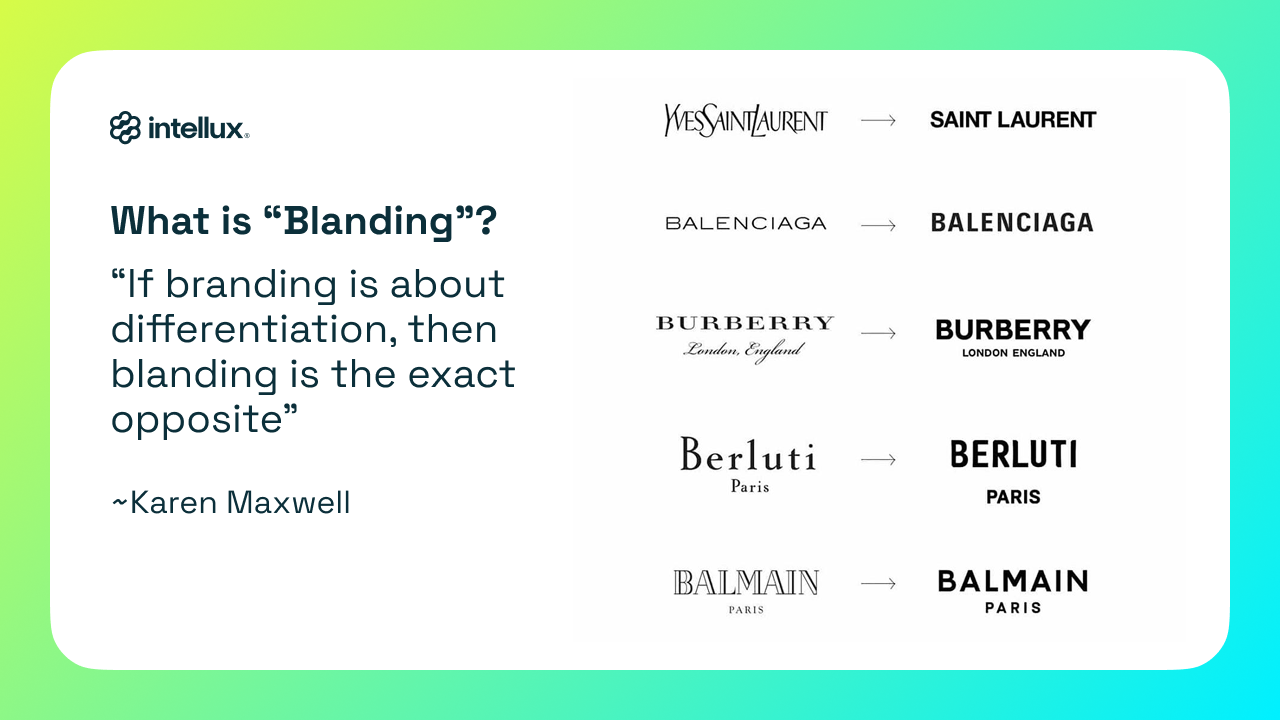
In the luxury market, this process became even more evident. Brands such as Burberry, Balenciaga, Celine, Calvin Klein, Saint Laurent, Rimowa, and Balmain were mentioned in analyses about logos that became visually similar after adopting more neutral typography. According to The Zoe Report, these new identities became “virtually indistinguishable” in some cases.
In practice, blanding grew because many companies started prioritizing adaptation, speed, and standardization over differentiation. With that, neutral fonts, solid colors, and minimalist compositions became safe choices for digital environments. However, when many brands follow the same formula, visual identity stops highlighting the company and starts blending it into the market.
Visual standardization did not appear by chance.
With social media, e-commerce, apps, and digital ads, brands started needing identities that worked across different screens and formats. For this reason, many companies chose simpler logos, sans-serif fonts, and more flexible compositions.
However, this choice also created a side effect. Exame points out that adaptation to digital, pressure for speed, and the search for economical solutions helped make logos more similar. The article also highlights that Burberry’s redesign was completed in just four weeks, prioritizing efficiency and speed.
"It is essential to preserve elements that connect the audience to the brand’s history and values. A poorly planned change can generate rejection, especially among consumers with a strong emotional bond. Success lies in the balance between modernity and tradition.”
~ Ivan Martinho, professor of sports marketing at ESPM
In addition, experts cited by Exame explain that uniform letters, typography without ornaments, and more neutral identities improve functionality. However, these same elements reduce brands’ ability to differentiate themselves. Therefore, the problem is not just minimalist aesthetics, but the repeated use of the same solution by different companies.
The audience reacts when it feels that a brand has lost connection with its history, product, or original promise. For this reason, rebrandings that move too far from the previous identity often generate fast criticism on social media.
The Jaguar case shows this risk clearly. In 2024, the brand launched a new visual identity and a car-free campaign with a futuristic aesthetic and the slogan “Copy Nothing.” The reaction was intense, with criticism on X and Instagram questioning whether the brand still sold cars and whether it had abandoned its visual heritage. In addition, the comments on the brand’s own video show the many criticisms the campaign received.
Users called the campaign a joke and said the brand had “killed a British icon.” They also added: “The only brave action about this ad was leaving the comment section open.” In Jaguar’s Instagram comments, part of the audience also asked for the traditional identity and the leaping cat symbol to return.Rejection also appears when the audience feels that AI in marketing was used only as a shortcut. In this case, the criticism is not only aimed at the technology, but at the feeling that the brand replaced creative intention with automated production.
Coca-Cola faced this debate with Christmas campaigns made with generative AI. In 2025, Euronews reported a new wave of criticism toward the brand’s Christmas ad, with recurring terms such as “soulless,” “creepy,” and “boycott.” The publication also highlighted that many users criticized the replacement of artists and the loss of authenticity in a campaign historically linked to emotion.

Therefore, the point is not to “stop using AI in marketing.” The risk is using AI without connection to branding, without considering the audience, and without respecting the brand’s personality. This is why startups need to treat identity, tone of voice, visual style, keywords, and content pillars as strategic data before generating texts, images, and campaigns.
One of the strongest examples of how AI can optimize marketing without turning a brand into something generic is Coca-Cola’s Project Fizzion.
Coca-Cola presented Fizzion as a “design intelligence” system developed in collaboration with Adobe. The project’s goal is to transform traditional brand guidelines into intelligent and adaptable assets, allowing creative teams to produce content up to 10 times faster without compromising quality, integrity, or originality. The Coca-Cola Company
This point matters because Coca-Cola did not use AI to “invent a new brand.” Instead, the project was created precisely to protect and scale a visual identity built over decades.
Coca-Cola operates one of the most complex marketing ecosystems in the world, with more than 200 brands in more than 200 countries. For this reason, maintaining visual consistency, campaign tone, and brand recognition across so many markets is a huge operational challenge. The Coca-Cola Company
In this context, Fizzion was custom-developed to help designers generate content aligned with brand guidelines while preserving creative intention and human control. According to Adobe, the idea is for AI to follow creative intent, not replace the direction of the professionals responsible for the brand.
In other words, AI does not enter as a tool to standardize everything without personality. It enters as an optimization layer to ensure creative assets are produced faster without losing the elements that make the brand recognizable.
The Fizzion case helps separate two things that many companies still confuse.
Using AI generically means asking for loose content, without context, without a brand manual, without a defined tone of voice, and without strategy. In this case, the result tends to look like any other company using similar prompts.
Using AI for marketing optimization means feeding the technology with real brand information, such as visual identity, communication guidelines, creative style, audience, goals, and consistency standards.
This is exactly the difference that brings Coca-Cola’s case closer to Intellux’s proposal.
Just as Fizzion starts from brand guidelines to scale creativity with consistency, Intellux allows companies to register data such as tone of voice, visual style, keywords, fonts, and content pillars inside the platform.
This way, AI does not work in a vacuum. It starts creating texts, images, and plans based on the personality of the brand itself.
The market itself also shows that AI without creative care can trigger negative reactions. In 2025, AI-made advertising campaigns received criticism for feeling artificial, cold, or disconnected from the emotion expected by the audience. In Coca-Cola’s case, recent versions of AI Christmas campaigns sparked debate precisely because part of the audience missed the emotional familiarity of the classic commercials.
Therefore, Fizzion proves that when there is a strong branding foundation, AI can help scale consistency, adapt content to different contexts, and preserve the brand’s essence across more touchpoints.
Intellux presents itself as a digital marketing platform with AI that brings planning, creation, and execution together in an integrated workflow. According to the company itself, the platform was created to reduce dependence on multiple tools, specialists, and manual processes, working as a marketing structure on a single screen. Intellux
Within this model, brand personalization is a central point. The platform states that its AI learns about brand, voice, and audience to build editorial calendars, generate texts, create images, organize content, and support social media publishing. Intellux Solutions
One of the features that reinforces this logic is the brand manual inside Intellux’s own app.
This manual gathers important information about the company’s personality, such as tone of voice, visual identity, keywords, fonts, communication style, and other strategic elements. This data helps the AI understand how that brand should communicate, instead of generating loose or standardized content.

In practice, this means that AI does not start from a blank page. It uses the company’s own information to create content that is more coherent with the brand.
When a startup registers brand data inside the platform, this information can be used in different features, such as the text generator, content pillars, and image generation.
This helps maintain consistency between what the company publishes, how it speaks, which themes it prioritizes, and what kind of aesthetic it uses. Instead of each content piece feeling isolated, the brand starts building a more recognizable presence.
ia-para-marketing
This consistency matters because a brand’s identity does not appear only in its logo. It is also present in the words chosen, the style of posts, the images, the topics addressed, and the way the company positions itself.
A startup with a young, direct, and educational tone of voice should not publish overly formal texts just because it is using AI. In the same way, a premium, technical, and B2B company should not sound like an informal entertainment brand.
When AI understands these differences, it can support production without mischaracterizing the brand.
Consumers do not want to relate only to companies that publish a lot. They want to connect with brands that convey trust, coherence, and authenticity.
This perception appears in recent research on branding, loyalty, and consumer behavior. Edelman’s Brand Trust 2025 report shows that 73% of people say their trust in a brand increases when it authentically reflects today’s culture. The same report also points out that, among users of generative AI platforms, 91% use these tools in some way during the purchase journey, such as researching brands, comparing products, or summarizing reviews. Edelman
In other words, a brand needs to be recognizable both to people and to new AI-mediated digital environments.
Authenticity is no longer just a subjective detail in communication. It has started to directly influence purchase decisions and long-term relationships with consumers.
According to 2026 data from Clutch, 97% of consumers say authenticity is an important factor in their decision to support a brand. In addition, 85% say they have purchased from a brand specifically because it seemed authentic, while 81% have stopped supporting a company because it no longer felt genuine.
The same research shows that 70% of consumers are willing to pay more for brands perceived as authentic, 62% tend to recommend brands they consider truly authentic, and 70% associate long-term consistency with authenticity.
These data points show that the problem is not using AI, but using AI to create artificial communication that is disconnected from what the brand really is.
The idea that AI makes every brand look the same ignores one essential point: different tools generate different results depending on the quality of the data, strategy, and human direction.
A startup that uses AI without identity tends to look generic. On the other hand, a startup that uses AI with a brand manual, defined tone of voice, clear pillars, and structured goals can produce more consistent and recognizable content.
Being consistent does not mean repeating the same sentence, the same layout, or the same type of post every time.
Consistency means maintaining a recognizable logic. A brand can vary formats, campaigns, themes, and channels, but it needs to preserve its personality.
This applies to captions, blog articles, images, ads, videos, emails, and social media posts. The more touchpoints a company has, the more important it becomes to have a clear brand foundation.
Intellux proposes exactly this type of organization. The platform brings together features such as AI editorial calendar, text generator, image generator, image editor, creative evaluation, and post scheduling in the same environment. Intellux Solutions
For startups, this can mean more autonomy and less dispersion across tools. According to Intellux itself, the user defines the brand profile, audience, and goals, while the AI organizes the next steps and executes part of the most labor-intensive tasks. Intellux Blog
This way, AI does not need to take over the company’s personality. It can operate from it.
Adopting AI does not mean giving up the brand’s essence. In fact, strategic use of technology can make this essence clearer, more consistent, and more present in the marketing routine.
For that to happen, AI needs context. It needs to understand how the brand speaks, which themes it defends, which visual elements it uses, which words represent its positioning, and what kind of relationship it wants to build with the audience.
Intellux shows this path by combining automation with brand data. Instead of encouraging generic communication, the platform allows each company to use its own identity as the foundation for generating more aligned content, images, and plans.
In the end, the question is not whether AI will make all startups look the same.
The right question is: is your brand giving AI enough information to show what makes it unique?
Continue exploring related content that might interest you