
Digital marketing


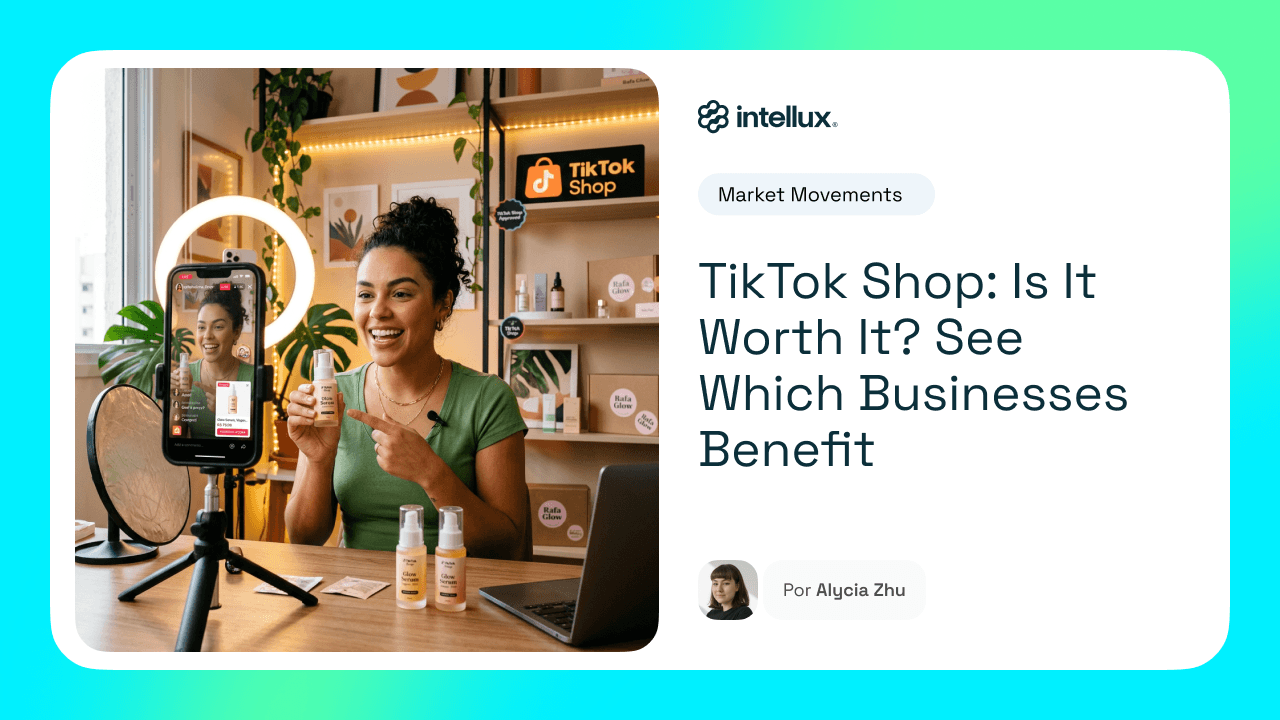
TikTok Shop has transformed videos, livestreams, and creator recommendations into a shopping journey integrated into the social media platform. With the platform’s growth in Brazil, brands and professionals have started considering the channel as a new opportunity to reach customers and generate sales.
However, TikTok Shop does not work the same way for every business model. While physical products and affiliate personal brands find more direct opportunities, services, software, courses, and other digital products face restrictions that prevent them from being sold within the marketplace.
Therefore, determining whether TikTok Shop is worth it requires looking beyond the platform’s popularity. Businesses must consider its rules, fees, margins, product formats, and their ability to produce content before deciding whether the channel truly fits their operation.
It is primarily worth it for physical products and personal brands that work as affiliates. For services and digital products, the answer is different: they cannot be sold directly through TikTok Shop Brazil, although TikTok can still be useful for building an audience, generating demand, and attracting leads.
The numbers show that there is a market, but they do not prove that every operation will be profitable. Profitability depends on margins, pricing, logistics, consistent content production, and the ability to work with creators.
| Business model | Is TikTok Shop worth using? | Verdict |
|---|---|---|
| Personal brand, such as FLM or CGC | Yes, mainly as an affiliate | High potential |
| Physical product | Yes, depending on the category and margin | Greatest opportunity |
| Local services | Not for direct sales | Use TikTok, not the Shop |
| Digital product or SaaS | Not for direct sales | Use it for customer acquisition |
Yes, especially as an affiliate creator and CGC.
A personal brand does not necessarily need to hold inventory or develop its own product. It can promote physical products from other stores and earn commissions from sales made through videos, livestreams, and the product showcase on its profile.
In Brazil, an affiliate creator must:
Approved creators can display products on their profiles, add shopping links to videos, and sell products during livestreams.
TikTok itself states that the average number of active affiliates in Brazil increased 46-fold during the Shop’s first year. The platform also published cases of female creators who generated more than R$1 million in GMV through content and livestreams. Since these figures were published by the company itself, they should be viewed as success stories rather than guaranteed average results.
It is more likely to be worthwhile when the personal brand:
Examples include beauty, fashion, home décor, cooking, organization, technology, pets, sports, and lifestyle.
It may not be worthwhile when a profile begins promoting any product solely to earn commissions. In this scenario, the personal brand risks turning all of its content into advertising and weakening its authority. In addition, frequently sharing products with poor reviews or questionable quality may result in multiple reports against the profile.
In this situation, assess which products are genuinely part of your life and daily routine as a content creator. Based on that assessment, select the products you will promote. This helps ensure that your profile’s audience is genuinely interested, resulting in more commissions and stronger customer trust.
Verdict for personal branding: It is worth testing, especially as an affiliate for physical products that align with the person’s positioning. You do not need to open your own store just to begin working as a creator.
TikTok Shop was primarily created to sell physical goods within the content journey. In Brazil, the platform’s average daily GMV increased 102-fold between May 2025 and May 2026. The average daily number of livestreams increased 20-fold, while the GMV generated through livestreams grew 161-fold during the same period.
An independent analysis by Momentum Works and Tabcut estimated that TikTok Shop’s monthly GMV in Brazil reached US$46.1 million in August 2025, only three months after reaching US$1 million. The study also showed that the platform was still significantly smaller than Mercado Livre and Shopee, despite its rapid growth.
Itaú BBA described Brazil’s competitive environment as one of the most challenging it had ever observed, partly because of TikTok Shop’s expansion. The data used by the bank also indicated a GMV of US$46.1 million in August 2025.
The most suitable products usually have:
According to EMARKETER, the best-selling products on TikTok Shop tend to combine affordable prices, impulse-purchase appeal, trends, and strong promotion by creators. Beauty products, accessories, home goods, fashion, and cosmetics are among the categories with the strongest fit.
During its first year in Brazil, TikTok itself highlighted the following among its best-selling products:
Products that are highly technical, expensive, or require a lengthy rational comparison may encounter greater difficulty. A specialized article from E-Commerce Brasil notes that beauty products, gadgets, household items, affordable fashion, and fast-moving consumer goods have a stronger fit, while technical and high-ticket products face more complex decision-making cycles.
Simply uploading a product catalog to the platform is also not enough. The channel requires:
Treating TikTok Shop as though it were simply another Mercado Livre or Shopee often leads to frustration because much of the demand must be generated through content.
Starting on July 15, 2026, two days after the date of this analysis, the official fee structure will be:
| Price after the seller’s discount | Commission | Fee per item |
|---|---|---|
| Less than R$50 | 10% | R$4 |
| R$50 or more | 6% | R$6 |
Until July 14, 2026, the stated commission is 6%, and the fee per item is R$4, according to information published by TikTok Shop itself.
Considering only the fees that take effect on July 15:
| Product price | Platform fees | Effective percentage |
|---|---|---|
| R$30 | R$7 | 23.3% |
| R$49.90 | R$8.99 | 18% |
| R$50 | R$9 | 18% |
| R$100 | R$12 | 12% |
| R$200 | R$18 | 9% |
These amounts are calculated before deducting:
Therefore, a very inexpensive product with a low profit margin may generate many sales while still producing little profit.
Packaged or prepackaged food and nonalcoholic beverages may be authorized when the seller complies with the applicable regulations.
Verdict for physical products: It is worth it, especially for visual, demonstrable products that encourage quick purchasing decisions and offer sufficient margins. This is the business model that is most compatible with the platform.
It is not worth trying to sell the service directly through the Shop
Brazil’s policy is clear: all services, including subscriptions, are prohibited on TikTok Shop, regardless of whether they are physical or virtual.
This means the following cannot be listed as products:
Tickets, coupons, and products that function solely as access to a service are also included among the prohibited items.
It is important to distinguish TikTok as a social media platform from TikTok Shop as a marketplace. Service professionals can use TikTok as a social network to:
However, in these cases, the final conversion takes place outside TikTok Shop, and the social media platform is used as a customer acquisition channel. A nail technician, for example, could sell an authorized physical product through the Shop, such as a nail care kit. However, they could not directly sell an appointment time.
Verdict for services: TikTok is worthwhile, but TikTok Shop is not. The Shop can only serve as a complementary channel when the professional also sells physical products.
Digital products cannot be sold directly, and the platform’s own policy expressly prohibits the sale of products such as:
The prohibition directly affects martechs, SaaS companies, digital courses, e-books, templates, apps, and subscription-based membership programs. Martechs are included in the platform’s prohibition, along with other startups whose systems include the following:
TikTok as a social media platform can function as a discovery, education, and demand-generation channel. The strategy would involve producing videos that show:
Interested users would then be directed to a landing page, product demonstration, form, or trial outside the Shop.
This is aligned with the social commerce model described by McKinsey: content, discovery, and community reduce the distance between a consumer’s first contact with a brand and the commercial decision. However, the company must adapt its customer journey to the platform’s format.
Verdict for digital products: TikTok can be worthwhile. However, TikTok Shop expressly prohibits the sale of any type of subscription-based digital product.
The best way to define it is this: TikTok Shop is not merely a marketplace; it is a content, affiliate, and commerce operation. For suitable physical products, the potential is real. For services and digital products, the opportunity lies in using TikTok for media exposure and customer acquisition, not in selling directly through the Shop.
Continue exploring related content that might interest you